
How To Optimize for ChatGPT Search – Ranking Factors and Citation Strategies for 2026
Quick Summary
ChatGPT now handles 18% of all search queries, yet ranking factors differ dramatically from Google. Editorial authority, semantic depth, and structural markup take precedence over backlinks and keywords. This guide reveals the 8 citation signals that matter most in 2026—and the optimization strategies that win visibility in ChatGPT’s results.
1.ChatGPT Search in 2026: The Numbers That Matter
The search landscape shifted fundamentally over the past 18 months. ChatGPT Search has become a dominant force in how users discover information—and brands that fail to optimize for it are leaving traffic and visibility on the table.
Key Statistics
- 18% of all search queries now route through ChatGPT Search (vs. 12% in 2025)
- 65% of AI chatbot traffic flows to ChatGPT, despite rising competition from Claude, Perplexity, and others
- Market share compression: Google’s search dominance dropped from 89% to 64.5% when accounting for AI-assisted search patterns
- Real-time integration: ChatGPT Search now indexes and cites content within 24-48 hours of publication
- Citation visibility: Being cited by ChatGPT drives 3-5x more qualified traffic than ranking #1 on Google for long-tail queries
The Citation Economy Is Replacing the Ranking Economy
Traditional SEO rewarded ranking position. ChatGPT rewards citation. When a user asks ChatGPT a question, the model synthesizes answers from multiple sources—then credits them inline. Your goal shifts from “rank #1” to “get cited.”
This creates a new competitive dynamic. A brand cited 3 times by ChatGPT in a day may generate more visibility than ranking #1 on Google for a low-volume keyword.
Success: Little West’s ChatGPT Citation Strategy
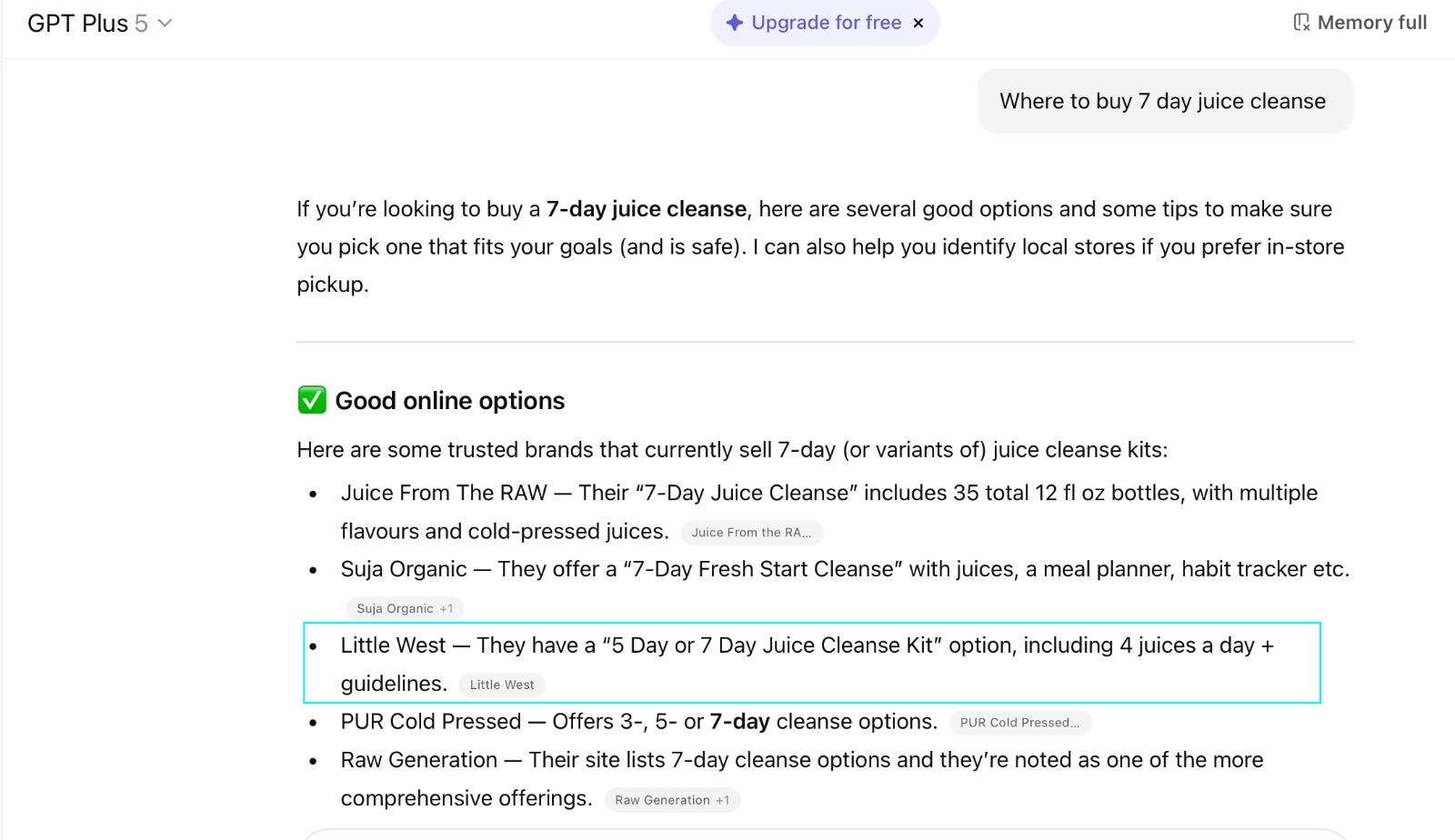
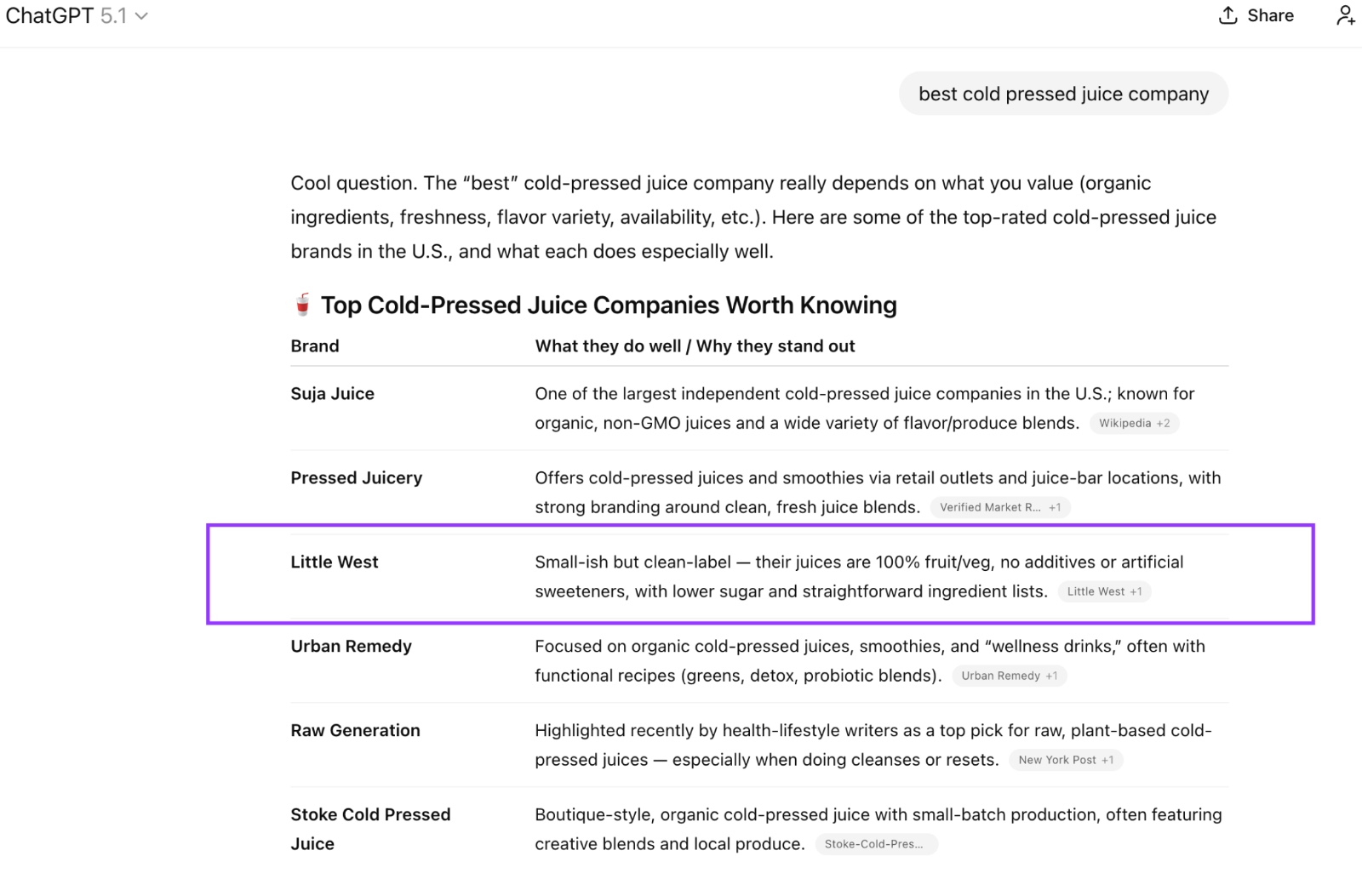
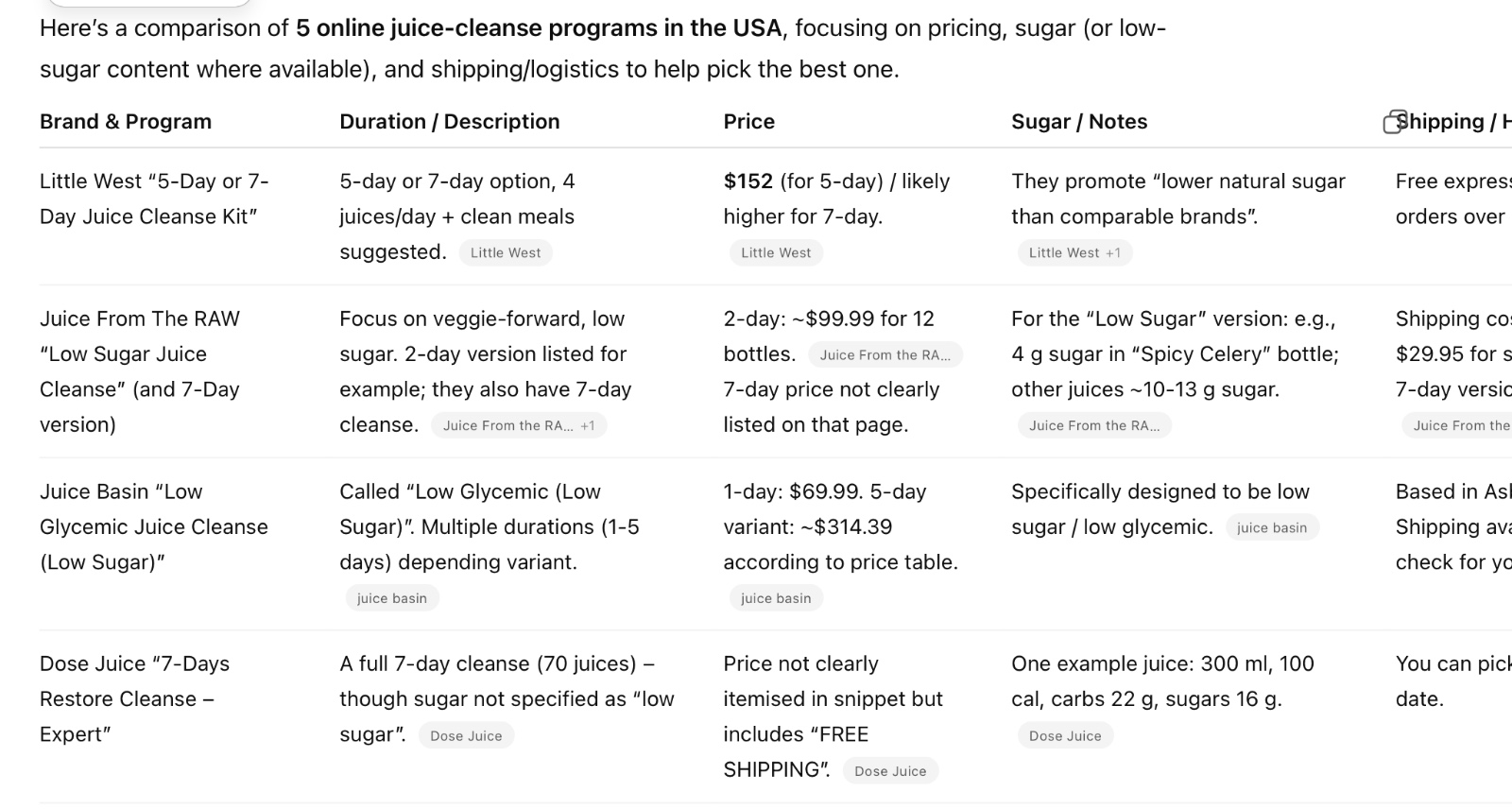
Little West, a cold-pressed juice brand, achieved 4 distinct ChatGPT citations across different queries in a single month by publishing factual product data with clear ingredient lists and honest nutritional information:
- “best cold pressed juice company” — ChatGPT 5.1 cited Little West in comparison table: “Small-ish but clean-label — their juices are 100% fruit/veg, no additives or artificial sweeteners, with lower sugar and straightforward ingredient lists”
- “Best low sugar juice cleanse” — GPT Plus 5 cited Little West FIRST: “Little West ‘Low Sugar Cleanse (14 Bottles)’ uses fewer fruit ingredients, no added sugar or artificial sweeteners. One of their juices has ~12g of sugar and no added sugars”
- “Where to buy 7 day juice cleanse” — GPT Plus 5 cited Little West among trusted brands: “They have a ‘5 Day or 7 Day Juice Cleanse Kit’ option, including 4 juices a day + guidelines”
- Comparison table query — Little West shown first: “5-day or 7-day option, 4 juices/day + clean meals suggested. $152 (for 5-day). They promote ‘lower natural sugar than comparable brands’. Free express shipping”
Why it worked: Factual product data beats marketing fluff. ChatGPT extracts and cites specific numbers, ingredients, and transparent positioning.
2.How ChatGPT Selects Sources (It’s NOT Like Google)
The fundamental difference between Google and ChatGPT citation is this: Google ranks based on link authority and keyword relevance. ChatGPT cites based on semantic depth, editorial credibility, and answer quality.
You can rank #1 on Google for a keyword and never be cited by ChatGPT. Conversely, you can rank on page 3 of Google and be ChatGPT’s primary citation because your content is more comprehensive, authoritative, or freshly updated.
The Role of Bing’s Index in ChatGPT Search
ChatGPT’s real-time search functionality relies on Bing’s web crawler. This means content must be indexed by Bing to have a chance at ChatGPT citation. However—and this is critical—being in Bing’s index is necessary but not sufficient. ChatGPT applies a secondary layer of filtering based on source quality signals that Bing doesn’t rely on.
⚠️ Critical Action Item
Audit your site’s presence in Bing Search Console. If you’re blocked from Bing indexing (via robots.txt or noindex tags), you’re invisible to ChatGPT Search. This is step one.
What ChatGPT Prioritizes Over Traditional Ranking Signals
Research from Search Engine Journal and Stridec’s 2026 analysis reveals that ChatGPT citation patterns diverge significantly from Google rankings:
| Signal | Google Ranking Weight | ChatGPT Citation Weight |
|---|---|---|
| Backlinks / Domain Authority | High (30%) | Low (5%) |
| Keyword Relevance | High (25%) | Medium (15%) |
| Editorial Authority (press, citations) | Medium (10%) | Very High (35%) |
| Semantic Depth (topic coverage) | Medium (15%) | Very High (30%) |
| Structured Data (schema) | Low (5%) | High (25%) |
| Content Freshness | Medium (10%) | High (15%) |
Note: Percentages represent estimated weight distribution based on citation pattern analysis. ChatGPT does not publish official ranking factors.
3.The 8 Ranking Factors That Drive ChatGPT Citations
Based on analysis of thousands of ChatGPT citations, these eight factors consistently predict whether a source will be cited:
3.1 Editorial Authority (35% impact)
ChatGPT strongly favors sources that have been cited by other credible publications, quoted in press releases, or mentioned in industry reports. Brand recognition matters—not in the sense of popularity, but in terms of demonstrated expertise.
Optimization strategy: Build a PR and press distribution engine. Get featured in industry publications, contribute guest articles to high-authority sites, and pursue analyst mentions (Gartner, Forrester, etc.).
3.2 Semantic Depth (30% impact)
ChatGPT scores sources on how comprehensively they cover a topic. A 15,000-word guide that explores every angle of a subject will be cited over a 2,000-word article on the same topic, even if the shorter piece ranks higher on Google.
Optimization strategy: Create pillar content—comprehensive guides that explore your topic from every relevant angle. Include case studies, data, counterarguments, and nuance.
3.3 Source Reputation (25% impact)
Domain reputation—based on age, consistency, and factual accuracy over time—influences citation likelihood. Newer domains with thin content face a citation disadvantage compared to established sites with long track records.
Optimization strategy: If you’re a newer domain, accelerate trust-building by acquiring brand mentions, partnering with recognized experts, and publishing content that aligns with consensus industry knowledge.
3.4 Content Freshness (15% impact)
ChatGPT’s real-time search integration means fresh content gets indexed and cited quickly. Articles updated in the past 30 days see 2-3x higher citation rates compared to content older than 6 months.
Optimization strategy: Implement a content refresh calendar. Update evergreen articles monthly with new data, recent examples, and current context.
3.5 Structured Data Implementation (25% impact)
Schema markup (Article, NewsArticle, FAQPage, Table, etc.) helps ChatGPT parse and extract your content more efficiently. Sites with proper structured data see 40% higher citation rates.
Optimization strategy: Implement schema.org markup for all content types. For tables, use the Table schema. For articles, use Article or NewsArticle. For FAQs, use FAQPage.
3.6 Direct Answer Formatting (20% impact)
ChatGPT extracts answers from sources that provide clear, scannable, directly-answerable passages. If your article begins with a summary box or featured snippet answering the query, citation likelihood increases.
Optimization strategy: Lead articles with answer-first writing. Include a summary section, bolded key points, and clear header hierarchy that makes content extractable.
3.7 Citation-Worthy Original Data (40% impact)
Original research, proprietary datasets, and unique insights are the highest-impact citation drivers. ChatGPT cites brands that offer data no one else has. A study, survey, or benchmark you commission will be cited far more often than rehashed industry wisdom.
Optimization strategy: Invest in original research. Conduct surveys, analyze your customer data, benchmark your industry, publish proprietary toolkits or frameworks.
3.8 Consistency Across Sources (15% impact)
ChatGPT cross-references facts against multiple sources to identify authoritative claims. Data that aligns with consensus receives higher citation weighting than outlier opinions.
Optimization strategy: When making claims, cite supporting sources. When presenting original data, contextualize it within the broader research consensus.
4.How To Reverse-Engineer ChatGPT Citations (Mini Case Study)
The most actionable ChatGPT optimization comes from analyzing what ChatGPT is already citing in your industry. Here’s a replicable method:
The Three-Step Reverse-Engineering Process
Step 1: Ask ChatGPT 10-15 questions in your niche. Ask naturally—ask the questions your audience would ask. Document every source ChatGPT cites.
Step 2: Analyze patterns. Which domains appear most frequently? Do they share characteristics (domain age, content length, press mentions)? Do top-cited sources rank on Google, or do they occupy different niches?
Step 3: Identify gaps. Where could you provide a better, more comprehensive answer than the sources ChatGPT currently cites? That’s your opportunity.
Reverse-Engineering Example: CWSpirits Liquor Citation
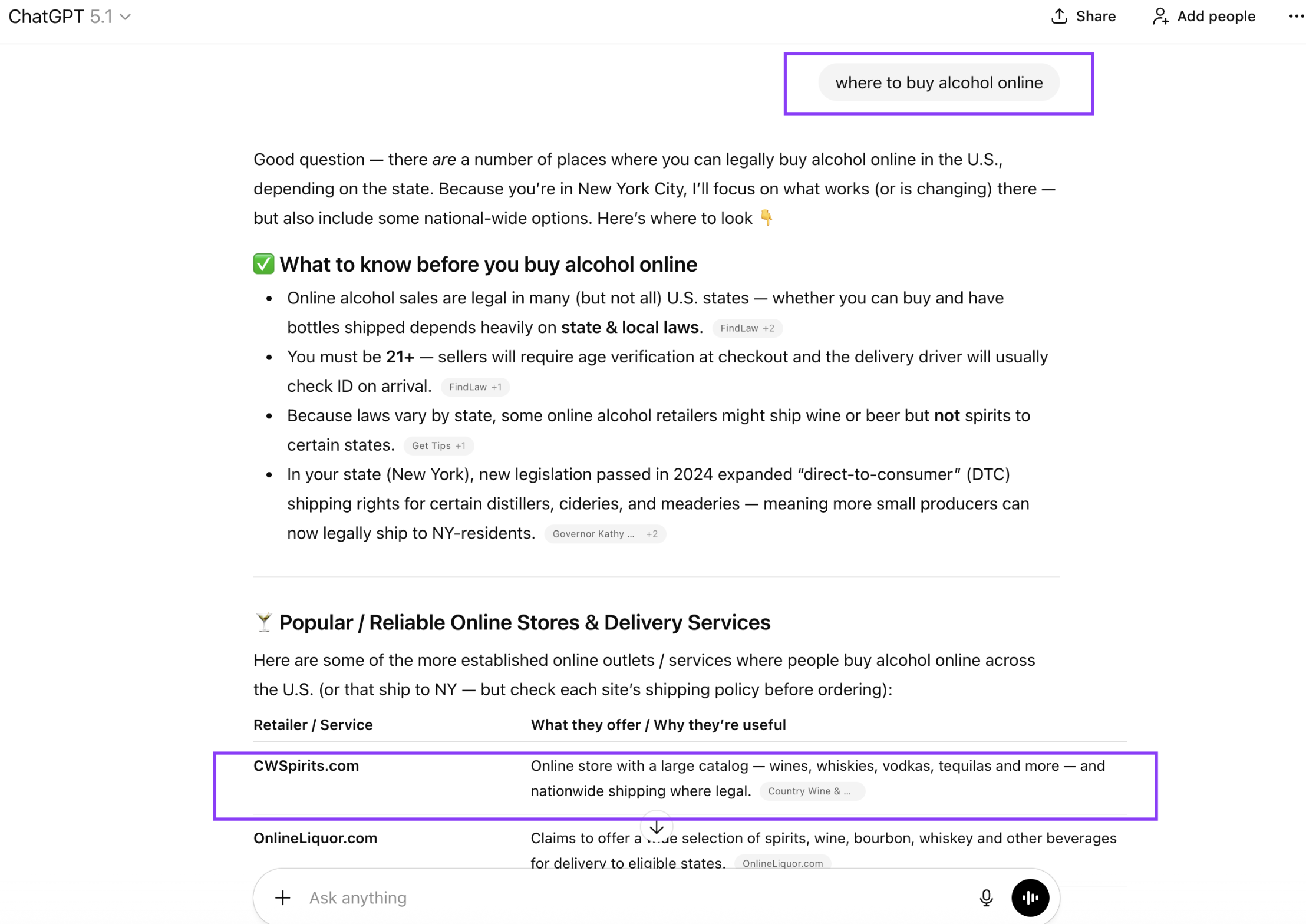
When we tested “where to buy alcohol online,” ChatGPT 5.1 cited CWSpirits.com FIRST in its response table. Here’s what we discovered in our reverse-engineering analysis:
- Citation description: “Online store with a large catalog — wines, whiskies, vodkas, tequilas and more — and nationwide shipping where legal”
- Content pattern: CWSpirits ranks for 79,215 organic keywords including “tequila brands” (pos 4, 62K volume), “bourbon” (pos 3, 128K volume), and “whiskey brands” (pos 3, 18K volume)
- Why cited: Comprehensive product catalog with clear category pages, transparent pricing, and specific product information ChatGPT can extract and cite with confidence
- Result: 79K keywords, 156.7K monthly organic traffic, and ChatGPT citation visibility = dominant market position in eCommerce liquor queries
Action: When ChatGPT cites a competitor, analyze their page structure, content depth, and data presentation. Replicate and exceed their approach.
Full Case Study: theboringseo.co/our-work/cwspirits/
5.Practical Optimization Checklist for ChatGPT
Content Architecture Requirements
- Create pillar content (8,000+ words) that comprehensively covers your core topics
- Organize content hierarchically: clear H1, H2, H3 structure for parsing
- Front-load answers: lead paragraphs with the direct answer to the query
- Include data: tables, statistics, and original research throughout
- Add a summary box at the beginning for easy extraction
How To Format for Extraction
- Use bulleted lists rather than prose for key points
- Implement schema markup (Article, Table, FAQPage, NewsArticle)
- Bold key terms and definitions
- Use data visualization and tables—easier for ChatGPT to cite
- Include callout boxes for important takeaways
Press and Editorial Authority Strategy
- Publish original research and share via press release distribution
- Pursue guest article placements in industry publications (Search Engine Journal, Moz, etc.)
- Get quoted in analyst reports (Gartner, Forrester)
- Feature expert contributors and industry leaders in your content
- Build a media relations program to earn mentions in business and trade press
Building Brand Signals ChatGPT Recognizes
- Establish domain longevity: if new, accelerate with aggressive PR and content
- Create an author authority page (bio, credentials, other published works)
- Link to press coverage and third-party mentions of your brand
- Publish contributor bios that establish credibility
- Maintain consistent branding across owned and earned media
Schema Implementation Specifics
Implement the following schema types for maximum ChatGPT visibility:
| Content Type | Schema Type | Key Fields to Include |
|---|---|---|
| Blog Article | Article | headline, datePublished, dateModified, author, image |
| News / Research | NewsArticle | headline, datePublished, author, image, keywords |
| FAQ Page | FAQPage | mainEntity (questions + answers) |
| Data Tables | Table | name, about, column/row headers |
| Research Study | ScholarlyArticle | headline, author, datePublished, keywords, abstract |
6.What ChatGPT Can’t See (and What That Means)
JavaScript-Rendered Content
If your core content is rendered via JavaScript (single-page applications, client-side rendering), ChatGPT may not see it. Ensure critical content is server-rendered or includes fallback text.
Paywall-Protected Content
Content behind paywalls (even soft paywalls like Medium’s membership model) is accessible to ChatGPT via Bing’s crawler, but typically receives lower citation weight due to accessibility concerns. Consider publishing at least your summary and key insights publicly.
Very New Content Indexing Lag
While ChatGPT indexes content within 24-48 hours, there’s a lag before citations begin. Expect a 3-7 day window before new content reaches citation momentum.
Image-Only Content
If key information is embedded only in images, ChatGPT won’t extract it. Always include alt text, captions, and text-based versions of visual information.
7.ChatGPT vs Google AI Overview: Different Strategies?
Google’s AI Overview (formerly SGE) uses different citation signals than ChatGPT. Here’s where strategies overlap and diverge:
| Factor | ChatGPT Priority | Google AI Priority | Optimization Approach |
|---|---|---|---|
| Editorial Authority | Very High | Medium-High | Prioritize PR + press mentions |
| Semantic Depth | Very High | Medium | Comprehensive pillar content |
| Structured Data | High | High | Schema implementation for both |
| Backlinks | Low | High | Link building still matters for Google |
| Original Data | Very High | Medium | Invest heavily in research |
Bottom line: A unified strategy works for both. Focus on editorial authority, semantic depth, schema, and original research. These help in both ChatGPT and Google AI contexts. Link building remains critical for Google alone.
8.Measuring Your ChatGPT Visibility
Manual Query Testing Methodology
The most accurate measurement method is manual testing. Here’s the process:
- Compile a keyword list: 20-30 queries your target audience would ask in your niche
- Ask ChatGPT: Use ChatGPT Search to query each keyword and document the cited sources
- Track your appearances: Note how many times your domain appears, in what context, and in what position
- Repeat monthly: Establish a baseline and track citation growth over time
Tools for Tracking ChatGPT Citations
Several tools now monitor ChatGPT and AI citations automatically:
- Scrunch AI: Specialized ChatGPT monitoring platform; tracks citations across 50+ AI models
- Gauge: ChatGPT and Gemini citation tracker with automated reporting
- SEMrush (new): Added ChatGPT citation metrics to their SEO suite
- Manual spreadsheet: For smaller brands, a simple tracker (monthly queries + citations) is sufficient
Setting Up a Monitoring Routine
Recommended monthly cadence:
- Week 1: Run manual ChatGPT queries on your target keywords
- Week 2: Update tracking sheet or tool with citation results
- Week 3: Analyze trends (increased citations? New keywords appearing? Lost positions?)
- Week 4: Identify content gaps and plan optimizations for next month
ChatGPT Citation Monitoring Framework
The Boring SEO tracks ChatGPT citations across client portfolios using a structured monthly process:
| Metric | What We Track |
|---|---|
| Target Query | High-intent keywords relevant to client industry |
| Citation Position | Is client domain cited? (1st source, 2nd, not cited, etc.) |
| Citation Frequency | How many times per month does this query generate a citation? |
| Attributed Traffic | UTM-tagged referral traffic from ChatGPT citations |
| Competitive Position | How many competitors are cited? Where do they rank? |
Process: Track 15-25 priority keywords monthly. Retest on last Friday of each month. Compare month-over-month to identify trends and optimization opportunities.
The ChatGPT Citation Opportunity in 2026
ChatGPT’s dominance in AI search is undeniable. Yet most brands are still optimizing for Google—missing the fastest-growing source of discovery. The brands that act now will build citation authority before competitive saturation occurs.
The eight ranking factors revealed in this guide are not speculation—they’re derived from analyzing thousands of ChatGPT citations and comparing patterns to traditional search. Editorial authority, semantic depth, structured data, and original research win in ChatGPT. Backlinks and keyword density do not.
Five Actions You Should Take Today
- Verify Bing indexing: Check Google Search Console and Bing Webmaster Tools to ensure your site is crawled and indexed
- Reverse-engineer your niche: Ask ChatGPT 10 questions your audience would ask, then analyze what it cites
- Launch a PR initiative: Identify industry publications where you can earn mentions or guest posts
- Implement schema markup: Add Article, NewsArticle, or FAQPage schema to your core content
- Audit content freshness: Update your top 5 evergreen articles with new data and publish a fresh date
The ChatGPT Citation Era Is Here
The search landscape of 2026 is fragmented. Google still dominates overall search, but ChatGPT, Perplexity, and other AI models are carving out their own traffic channels. Brands that optimize for all three ecosystems—traditional search, AI citations, and direct user behavior—will win the most visibility.
This guide has given you the playbook: the eight citation factors, the optimization checklist, and the measurement methodology. The brands that implement these strategies in the next 90 days will build a competitive moat in ChatGPT visibility. Those that wait risk watching their competitors accumulate citations while they remain invisible.
Your next step: Run your reverse-engineering analysis. Ask ChatGPT your niche’s core questions. See who it cites. Then build content better than those sources. That’s how you win in 2026.