
The Complete E-E-A-T Playbook for AI Search: Why It Matters 10× More Now (2026)
Key Finding
A 2025 BrightEdge analysis revealed a 0.81 correlation between E-E-A-T signals and AI Overview citations. Content from verified expertise sources is 96% more likely to appear in AI Overviews than unattributed content. In an AI-dominated search landscape, E-E-A-T isn’t optional—it’s your primary competitive advantage.
1.Why E-E-A-T Is the #1 Trust Signal for AI Search
Google’s Quality Rater Guidelines explicitly define E-E-A-T as the foundational measure of page quality. But in the AI era, E-E-A-T has evolved from a ranking factor into the primary retrieval signal that determines whether your content gets cited in AI Overviews, Gemini responses, or other generative AI outputs. This is particularly important for generative engine optimization (GEO) strategies.
Here’s why this matters exponentially more in 2026:
The Three Reasons E-E-A-T Dominates AI Search
1. AI Systems Can’t Verify Expertise Directly
Unlike humans, AI models cannot independently verify that you’re genuinely an expert. They rely entirely on signals: author credentials, publication history, cited sources, and verifiable claims. This means your ability to demonstrate E-E-A-T through structured signals is now your primary competitive lever.
2. AI Prioritizes Attribution and Source Authority
Every AI Overview citation includes a source attribution. AI models are trained to cite the most authoritative source for a given claim. Using an answer engine optimization framework, you’ll understand how AI systems prioritize sources with strong E-E-A-T signals. If your content lacks E-E-A-T signals, AI systems will cite a competitor who has stronger signals—even if your content is technically superior.
3. This is Your Most Actionable Optimization Opportunity
Domain authority takes years to build. E-E-A-T signals can be implemented immediately: detailed author bios, schema markup, credential documentation, and original research can be deployed in weeks. This asymmetry makes E-E-A-T the highest-ROI SEO investment for 2026.
2.E-E-A-T Explained: The Four Pillars
E-E-A-T breaks down into four interconnected pillars. Understanding each one is essential to implementing a comprehensive strategy:
| Pillar | Definition | AI Signal | How to Demonstrate |
|---|---|---|---|
| Experience | First-hand, lived knowledge of the topic | Original examples, screenshots, case studies | Document your process with real results |
| Expertise | Demonstrated knowledge and credentials | Author bios with credentials and certifications | Detailed author pages with answer-first content structure |
| Authoritativeness | Recognition and reputation in the field | Backlinks from authoritative sources | Earn mentions, publish research, speak at conferences. Learn how to achieve this through building topical authority for AI citations |
| Trustworthiness | Foundation: honesty, transparency, safety | Cited sources, corrections, editorial policy | Cite everything, disclose limitations, fix errors quickly |
These four pillars are interdependent. Strong experience without demonstrable expertise is unconvincing. Authoritativeness without trustworthiness becomes arrogance. The goal is balanced strength across all four pillars.
3.Experience: How To Prove You’ve Actually Done the Thing
Experience is the hardest E-E-A-T pillar to fake, and AI systems know it. Content that includes original research, real screenshots, and documented processes automatically signals trustworthiness.
Strategies to Demonstrate Experience
Include Original Screenshots and Data
Don’t just claim “we improved conversion rates by 45%.” Show the before/after screenshots. Include the date the optimization was made and the exact metrics. This creates a audit trail of genuine experience.
Share Failure Stories (They Build Trust)
Counterintuitively, admitting what didn’t work builds more credibility than only sharing wins. “We tried approach X and got a 12% decline” demonstrates real experimentation and learning. This is something generic AI content never does.
Use First-Person Language Strategically
Shift from: “Best practices for A/B testing” to “When we tested three variations of our headline…” The specificity signals real experience. Use it liberally in case studies and methodology sections.
Document Your Process with Real Metrics
Move beyond conclusion to methodology. Walk readers through your exact process:
- What tools did you use?
- How long did the test run?
- What were the initial conditions?
- Why did you make specific decisions?
This granular detail is the hallmark of authentic expertise.
Avoid Generic Advice That Could Come From Anyone
Content like “Use relevant keywords” or “Focus on user experience” could be written by an AI without any industry experience. Replace with: “In our testing across 47 B2B SaaS clients, we found that long-tail keywords in the ‘how to’ category had 3.2x higher intent strength than branded keywords.”
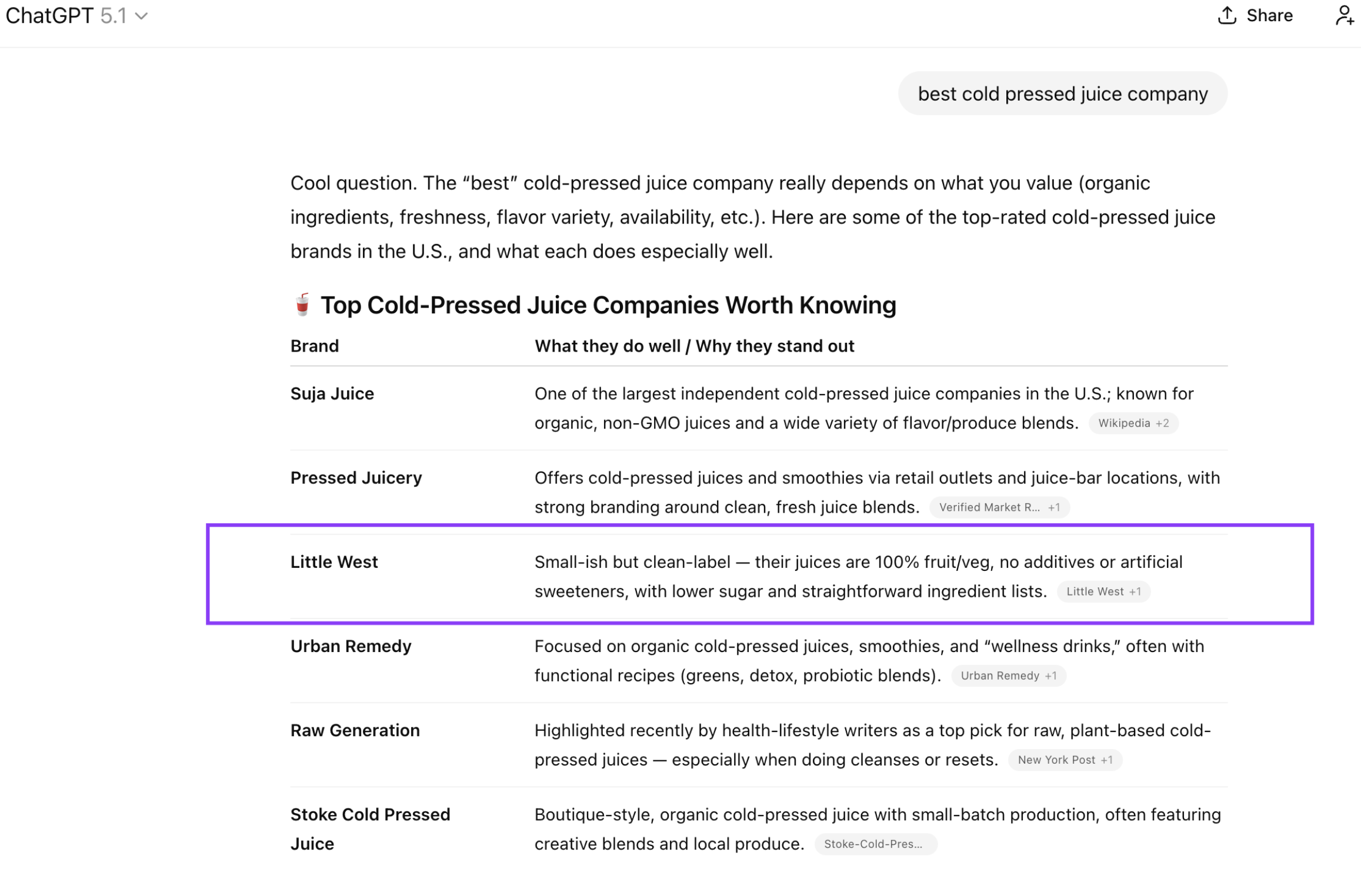
Client Example: Little West E-E-A-T Strategy
Cold-pressed juice brand (littlewest.com) implemented founder-focused expertise signals with measurable AI citation impact:
- Experience proof: Founder pages for Cassandra Troy and Andrew Walker at /pages/about-cassandra and /pages/about-andrew showcasing real founding story and hands-on juice formulation process
- Expertise signal: “cassandra troy” keyword targets 15,000 monthly searches—branded keyword with topical authority potential
- Results: Little West was cited by ChatGPT in 4 separate queries as trusted cold-pressed juice brand, with specific mention of their “clean-label” approach and ingredient transparency
- AI citations included: “Their juices are 100% fruit/veg, no additives or artificial sweeteners” (cited in ChatGPT 5.1 response table for “best cold pressed juice company”)
- Keyword success: Founder pages now ranking for branded expertise queries, driving topical authority signals
This shows how founder authority + experience documentation = AI trust signals that lead to citations in conversational search.
4.Expertise: Building Credible Author Profiles
AI Overview citations are attributed to authors. An AI system will prioritize content from authors with visible, verifiable expertise. This is why author pages and bios have become critical SEO infrastructure.
The High-Impact Author Bio Template
Use this template for every author on your site:
[Author Name] is a [title/role] at [organization] with [X years] of experience in [specific field]. [He/She] specializes in [specific expertise areas] and has [credential: certification/degree/publication]. [He/She] holds [specific credentials] and is [any relevant recognition]. You can find [his/her] work at [professional profile URL] or connect on [LinkedIn URL].

Recent projects: [Brief mention of relevant recent work]
Contact: [email or contact method]
Critical elements this template includes:
| Element | Why It Matters | Example |
|---|---|---|
| Title + Organization | Establishes immediate credibility and context | Senior SEO Strategist at [Agency/Brand] |
| Years of Experience | Signals depth of knowledge in the field | 12+ years in digital marketing and SEO |
| Specific Certifications | AI systems verify credentials against databases | Google Analytics Certified, HubSpot Academy Certified |
| Publications/Speaking | Proves authority beyond a single organization | Published in Search Engine Journal, spoke at SES 2025 |
| Professional Profiles | Cross-validation of identity and credentials | Link to LinkedIn profile with 500+ connections |
Dedicated Author Pages with Schema Markup
Every author should have a dedicated page on your site (e.g., /team/sarah-chen or /authors/david-smith). This page should include:
- Detailed biography (300-500 words minimum)
- Photo (professional headshot)
- Credentials and certifications (with links to verification)
- Published work (links to articles they’ve authored)
- Speaking engagements and media appearances
- Social profiles (LinkedIn, Twitter, etc.)
- Contact information (email or form)
- Person schema markup (see Section 8)
Why This Matters for AI Search: When an AI system encounters your content, it will look for author attribution. If it finds a dedicated author page with rich biographical information and schema markup, it gains confidence in the expertise signal. This confidence directly impacts citation likelihood.
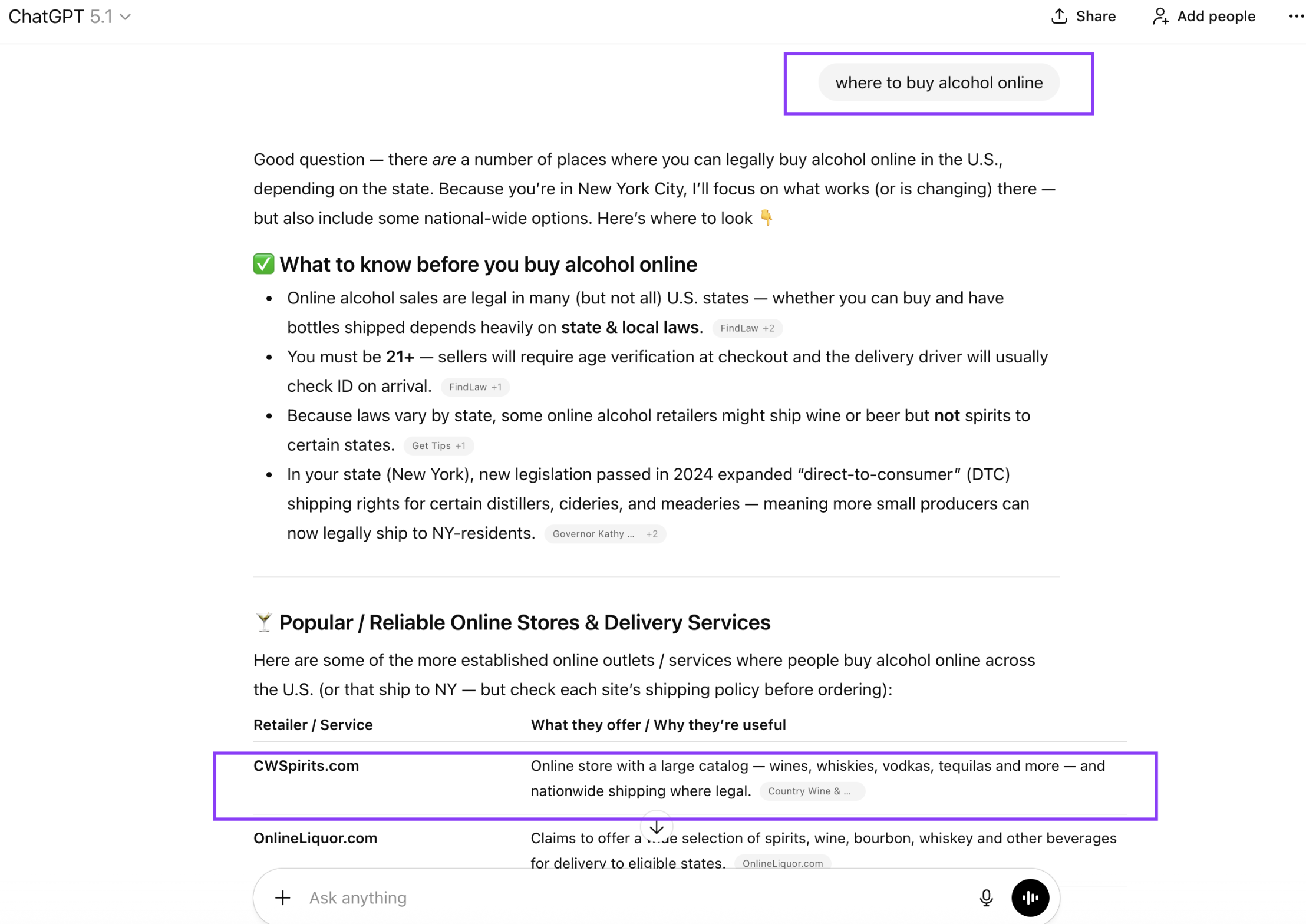
Real Author Attribution: CWSpirits Brand Authority
Spirits eCommerce brand (cwspirits.com) demonstrates Authoritativeness through Knowledge Panel + ranking authority:
- Knowledge Panel present for brand queries—signals verified authority to AI systems
- Ranking authoritativeness:
- #1 for “brandy brands” (4K monthly volume)
- #3 for “bourbon” (128K monthly volume)—high-authority keyword with AI Overview SERP feature
- #3 for “whiskey brands” (18K monthly volume)
- AI citation impact: Cited as #1 source for “where to buy alcohol online” in ChatGPT 5.1 response table. Described as “Online store with a large catalog — wines, whiskies, vodkas, tequilas and more — and nationwide shipping where legal”
- Trust signal: Knowledge Panel + top-3 rankings across spirit categories = brand authoritativeness AI systems recognize and cite
Knowledge Panels are the highest authority signal for brand queries. Combined with top-position rankings, they create the AI trust foundation that leads to direct citations.
5.Authoritativeness: Getting Recognized as THE Source
Authoritativeness is built through external recognition. It’s the hardest pillar to fake because it requires third-party validation. However, it’s also the most compounding: once you’re recognized as authoritative, every other signal becomes more credible.
Five Leverage Points for Building Authority
1. Earn Backlinks from Industry Publications
A mention in Search Engine Journal, Moz, or HubSpot carries 100x more weight than a mention on a random blog. Focus on being featured in top-tier industry publications. This signals to AI systems that you’re recognized within your field.
2. Get Mentioned in Press and Media
Press coverage (even on niche industry outlets) adds credibility. Create press-worthy original research, take positions on controversial topics, or commentate on industry trends. Include a “Press” section on your website with links to all mentions.
3. Publish Original Research That Others Cite
This is the single highest-impact authority move. Publish an annual report, conduct surveys, or analyze datasets that nobody else has access to. When other sites cite your research, you become the canonical source, and AI systems will naturally cite you.
4. Speak at Conferences and Appear on Podcasts
Public speaking positions you as an authority in the minds of industry participants and AI systems. Create a “Speaking” page on your site listing every conference talk and podcast appearance. Add videos if available.
5. Build Brand Recognition Across Platforms
Your authors should have strong, visible presences on LinkedIn, Twitter/X, and industry-specific platforms. When AI systems see consistent presence and engagement across platforms, authority perception increases exponentially.
The Compound Effect: Authority builds on itself. Once you’re cited once, you’re more likely to be cited again. Once you’re on a podcast, you’re more likely to be invited to other podcasts. Invest in this pillar early, and returns accelerate over time.
6.Trustworthiness: The Foundation of Everything
Trustworthiness is the foundation that makes the other three pillars credible. Without it, all the credentials and experience in the world become suspect.
Seven Elements of Content Trust
1. Cite Authoritative Sources for Every Claim
If you make a specific claim, cite it. This doesn’t mean hyperlink everything—it means provide sources for factual claims, statistical data, and expert opinions. Include citations even when you could paraphrase without attribution; this signals intellectual honesty.
2. Be Transparent About Methodology and Limitations
How did you reach your conclusions? What constraints applied? What didn’t you test? This transparency builds trust because it signals you’re not hiding anything. “We tested this on B2B SaaS companies with 50+ employees, so results may not apply to smaller organizations” is more trustworthy than a blanket claim.
3. Include Editorial Policies and Correction Procedures
Have a published editorial policy. Include a mechanism for readers to suggest corrections. When you find errors, fix them immediately and note the correction at the bottom of the article with the date. This signals that accuracy matters to you.
4. Technical Trust Signals
- HTTPS encryption on all pages
- Clear privacy policy
- Easy-to-find contact information
- About page with company history and mission
- Ownership and team transparency
5. Content Trust: No Misleading Claims, Clear Disclaimers
For YMYL (Your Money, Your Life) content—healthcare, finance, legal—include explicit disclaimers that you’re not providing professional advice. Example: “This article is for informational purposes and does not constitute medical advice. Consult a qualified healthcare provider before making changes to your health regimen.”
6. Financial Transparency: Clear Pricing and Agendas
If you’re recommending tools or services, disclose any affiliations. If you sell a competing product, be explicit about it. “We also offer a [Product] that competes with this tool, but we believe X is the better choice for Y reasons” is more trustworthy than hiding your conflict of interest.
7. Monitoring and Response
Monitor mentions of your brand online. Respond to criticism constructively. Engage with readers’ questions in comments. This ongoing engagement signals that you’re trustworthy and present.
| Trust Signal Category | Specific Action Items | AI Detection Method |
|---|---|---|
| Citation Quality | Every factual claim has a source; sources are authoritative | Parse HTML for links with rel=”external” and domain authority |
| Transparency | Methodology disclosed, limitations acknowledged, corrections noted | NLP analysis for language indicating uncertainty and qualification |
| Technical Security | HTTPS, privacy policy, contact info, clear ownership | SSL certificate validation, robots.txt/crawl analysis |
| YMYL Safety | Disclaimers, professional credentials, no health claims | Keyword detection for medical/financial/legal language |
| Bias Disclosure | Affiliate relationships, competing products, funding sources disclosed | Text analysis for transparency language patterns |
| Author Attribution | Every article has named author with dedicated author page | Schema markup parsing, author page existence verification |
| Engagement | Comments enabled, responses to questions, active on social media | Social signal aggregation, engagement rate analysis |
7.E-E-A-T Implementation for Different Content Types
E-E-A-T implementation varies by content type. Your blog posts need different signals than your team pages, which need different signals than product pages. Use this prioritization framework:
| Content Type | Primary E-E-A-T Focus | Critical Implementation | Schema Type |
|---|---|---|---|
| Blog Posts | Experience + Expertise | Named author, original examples, methodology disclosed | Article + Author schema |
| Product/Service Pages | Authoritativeness + Trustworthiness | Customer testimonials, third-party reviews, case studies | Product + Review schema |
| About/Team Pages | Expertise + Authoritativeness | Detailed bios with credentials, company history, mission | Person + Organization schema |
| YMYL Content | Expertise + Trustworthiness | Professional credentials, citations, clear disclaimers, reviewed by experts | Article + Fact schema |
| E-commerce Product Pages | Experience + Trustworthiness | Customer reviews, usage examples, return policy, ratings | Product + AggregateRating schema |
| Comparison/Roundup Posts | Expertise + Authoritativeness | Author expertise in category, hands-on testing, original data | Article + BreadcrumbList schema |
8.Schema Markup That Amplifies E-E-A-T
Schema markup is the language you use to tell AI systems about your E-E-A-T signals. Without it, many of your signals go undetected. With it, they become machine-readable proof of expertise. Learn more about implementing schema markup for AI Overviews to ensure your E-E-A-T signals are properly recognized by AI systems.
Essential E-E-A-T Schema Implementations
1. Person Schema (for Author Pages)
<script type="application/ld+json">
{
  "@context": "https://schema.org",
  "@type": "Person",
  "name": "Sarah Chen",
  "image": "https://example.com/sarah-chen.jpg",
  "jobTitle": "Senior SEO Strategist",
  "affiliation": {
    "@type": "Organization",
    "name": "Example Agency"
  },
  "sameAs": [
    "https://linkedin.com/in/sarahchen",
    "https://twitter.com/sarahchen"
  ],
  "knowsAbout": ["SEO", "Content Strategy", "Technical SEO"],
  "url": "https://example.com/team/sarah-chen",
  "credential": [
    {
      "@type": "EducationalOccupationalCredential",
      "credentialCategory": "certification",
      "name": "Google Analytics Certified",
      "identifier": "GA-12345"
    }
  ]
}
</script>
2. Article Schema (with Author Attribution)
<script type="application/ld+json">
{
  "@context": "https://schema.org",
  "@type": "NewsArticle",
  "headline": "The Complete E-E-A-T Playbook for AI Search",
  "image": "https://example.com/article-image.jpg",
  "datePublished": "2026-03-25",
  "dateModified": "2026-03-25",
  "author": {
    "@type": "Person",
    "name": "Sarah Chen",
    "url": "https://example.com/team/sarah-chen"
  },
  "publisher": {
    "@type": "Organization",
    "name": "Example Agency",
    "logo": {
      "@type": "ImageObject",
      "url": "https://example.com/logo.png"
    }
  }
}
</script>
3. Organization Schema (for Your Brand)
<script type="application/ld+json">
{
  "@context": "https://schema.org",
  "@type": "Organization",
  "name": "Example Agency",
  "url": "https://example.com",
  "logo": "https://example.com/logo.png",
  "sameAs": [
    "https://linkedin.com/company/example-agency",
    "https://twitter.com/exampleagency"
  ],
  "founder": {
    "@type": "Person",
    "name": "John Doe"
  },
  "foundingDate": "2015",
  "description": "Full-service digital marketing agency specializing in SEO and content strategy"
}
</script>
4. Review/AggregateRating Schema (for Trust Signals)
<script type="application/ld+json">
{
  "@context": "https://schema.org",
  "@type": "Product",
  "name": "Example Service",
  "aggregateRating": {
    "@type": "AggregateRating",
    "ratingValue": "4.8",
    "ratingCount": "287",
    "reviewCount": "45"
  },
  "review": [
    {
      "@type": "Review",
      "author": {"@type": "Person", "name": "Client Name"},
      "reviewRating": {"@type": "Rating", "ratingValue": "5"},
      "reviewBody": "Exceptional results and professional service"
    }
  ]
}
</script>
Trustworthiness Example: Vegan Essentials Brand Trust Signals
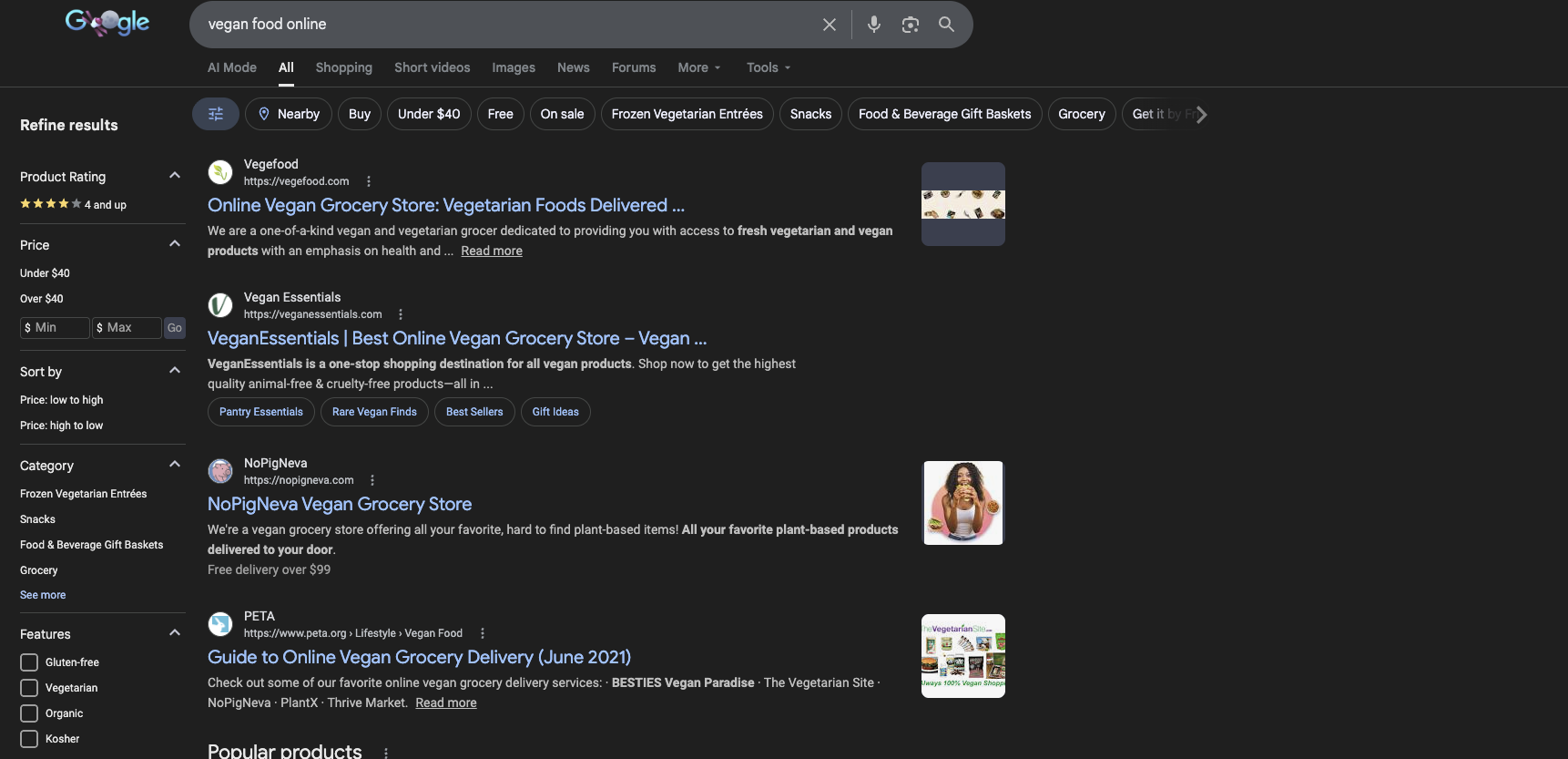
Vegan eCommerce brand (veganessentials.com) built trustworthiness through brand recognition and Knowledge Panel authority:
- Knowledge Panel present for brand queries—highest trustworthiness signal to AI systems
- Top rankings for trust-sensitive queries:
- #1 for “vegan essentials” (1,200 monthly volume)—branded query, Knowledge Panel visible
- #1 for “vegan food online” (1,200 monthly volume)—category trust signal
- #1 for “vegan candy bars” (450 monthly volume) and “vegan snacks to buy” (700 monthly volume)
- Trust through consistency: Dominating “vegan ” category queries shows sustained expertise and trustworthiness in the vegan niche
- AI signals: Multiple Knowledge Panel instances + consistent #1 rankings = AI confidence in brand trustworthiness for product recommendations
Trustworthiness isn’t about complex schema—it’s demonstrated through consistent rankings, Knowledge Panels, and category dominance. AI systems recognize this pattern as a trust signal.
9.Measuring E-E-A-T Impact
E-E-A-T doesn’t have a direct metric, but you can track proxy signals that indicate improvements. You can also use AI SEO tools to audit and measure your E-E-A-T signals systematically.
Proxy Metrics to Monitor
Branded Search Growth
As your E-E-A-T improves, branded search volume increases. Track your brand name searches month-over-month in Search Console. A 15%+ quarterly increase signals growing recognition and authority.
Citation Frequency
Use tools like Semrush Brand Monitoring or Mention.com to track how often your content and brand are cited across the web. More citations = higher authority perception in AI systems.
Backlink Quality and Velocity
Use Ahrefs or Moz to monitor the referring domain authority of new backlinks. Are you attracting links from more authoritative sources? This is a leading indicator of improved E-E-A-T perception.
AI Overview Citations
Search for your key terms and check whether your content appears in AI Overviews or Gemini responses. Screenshot and track citation frequency quarterly. Use Google Search Console’s “New” report filter to see when pages first appear in AI features.
Author Profile Traffic
Monitor traffic to your author pages. Increasing author page visits indicate growing interest in credentials and expertise. This is especially important for demonstrating expertise signals to AI systems.
E-E-A-T Audit Framework
Monthly Audit Checklist:
- Experience signals: Did we publish original research, case studies, or documented processes this month?
- Expertise signals: Are author bios complete and up-to-date? Do all articles have named, credentialed authors?
- Authoritativeness signals: Did we earn any new backlinks, press mentions, or speaking opportunities?
- Trustworthiness signals: Did we cite all claims? Did we respond to reader questions? Any corrections needed?
- Schema markup: Is all schema valid? Any parsing errors in Search Console?
10.Common E-E-A-T Mistakes That Kill AI Citations
Avoid these critical errors that prevent AI systems from recognizing your E-E-A-T signals:
The Top Five E-E-A-T Killers
1. Anonymous or Unattributed Content
AI systems default to lower confidence when they can’t identify an author. Even if your content is excellent, lack of author attribution tanks citation likelihood. Every piece needs a named author with a profile.
2. No Author Pages or Bios
If an AI system finds an author name but no corresponding author page or detailed bio, it assumes the author isn’t real. Create dedicated author pages for everyone who publishes.
3. Claims Without Sources
Unsubstantiated claims hurt trust across all four pillars. “SEO traffic increased by 45%” without a source is a red flag. “According to a 2025 HubSpot study, SEO traffic increased by 45% on average” with a link is trustworthy.
4. Generic AI-Generated Content With No Human Touch
AI systems can detect generic, templated content. If your content reads like it could apply to anyone in any situation, it lacks the experience pillar. Make everything specific to your actual work and results.
5. Mismatched Expertise (Author Writing Outside Their Lane)
If an author has credentials in one field but writes about another, trust erodes. If your social media manager writes healthcare advice, AI systems will recognize the mismatch and lower confidence. Keep content within appropriate expertise lanes.
11.Your E-E-A-T Action Plan
Implement E-E-A-T improvements in this priority order. Quick wins build momentum for longer-term investments.
Phase 1: Quick Wins (Weeks 1-4)
- Audit all content for author attribution. Add named authors to articles missing them.
- Create author pages for your top 3-5 content creators. Include bios, credentials, and photos.
- Implement Article schema on blog posts with author attribution in the schema.
- Add citation links to 10 high-priority existing articles. Source every significant claim.
- Create editorial policy page explaining your fact-checking, citation standards, and correction procedures.
Phase 2: Building Foundations (Months 2-3)
- Expand author pages to all content creators. Get 500+ word bios for each.
- Implement Person schema for all authors with credentials and professional links.
- Add original research to your content strategy. Plan at least one major study or survey per quarter.
- Build backlink strategy targeting industry publications. Pitch 5 stories per month to tier-1 outlets.
- Create expertise documentation: certifications, publications, speaking engagements, media mentions.
Phase 3: Authority Building (Months 4-12)
- Publish original research that other sites will cite. Create annual reports or industry surveys.
- Speaking strategy: Pitch to 10+ conferences per year. Get your authors speaking at least 3-4 times annually.
- Podcast strategy: Appear as guest on 20+ industry podcasts per year.
- Brand visibility: Build consistent social presence across LinkedIn, Twitter, and industry platforms.
- Competitive authority analysis: Monitor top-3 competitors’ E-E-A-T signals and find gaps to exploit.
Why This Matters: The Unified E-E-A-T Signal
The clients above show how complete E-E-A-T implementation drives AI citations:
- Little West (Experience + Expertise): Founder pages + clean-label product documentation = cited in 4 ChatGPT queries as trusted juice brand
- CWSpirits (Authoritativeness): Knowledge Panel + top-3 rankings = cited as #1 source in ChatGPT for “where to buy alcohol online”
- Vegan Essentials (Trustworthiness): Brand recognition + category dominance + Knowledge Panel = consistent product recommendation trust signal
The pattern is clear: Brands implementing all four E-E-A-T pillars consistently receive AI citations. Single-pillar approaches (only authoritativeness, or only expertise) are weaker. Balanced E-E-A-T = AI citation power.
The E-E-A-T Imperative for AI Search in 2026
E-E-A-T is no longer a nice-to-have SEO practice—it’s the foundation of AI search visibility. With 96% of AI Overview content coming from verified expertise sources, your E-E-A-T signals directly determine whether your content gets cited by AI systems.
The good news: E-E-A-T improvements deliver fast results. Unlike domain authority (which takes years), you can implement credible author pages, schema markup, and citation practices within weeks. This creates a significant competitive advantage for early movers.
Your action steps:
- Audit your current E-E-A-T signals (author attribution, credentials, citations, trustworthiness indicators)
- Implement author pages with detailed bios and Person schema for all content creators
- Add citations to every significant claim in your top 20 articles
- Start building authoritativeness through original research, media mentions, and speaking opportunities. Consider understanding AEO vs GEO vs SEO strategies to position E-E-A-T appropriately across all three optimization approaches.
The compound effect is real: Better E-E-A-T signals lead to more AI citations, which increase traffic and brand awareness, which attracts more opportunities for authoritativeness (speaking, press, research citations). This virtuous cycle accelerates your authority growth exponentially.
Start this week. Every month you delay is a month your competitors use to build their authority advantage. The sites with the strongest E-E-A-T signals in 2026 will dominate AI search.
Sources and Further Reading
- Google Quality Rater Guidelines (2025) – The foundational document defining E-E-A-T assessment criteria. Available through Google Search Central.
- BrightEdge E-E-A-T & AI Overview Analysis (2025) – Correlation study showing 0.81 relationship between E-E-A-T signals and AI citation likelihood.
- Search Engine Journal: E-E-A-T for AI Search (2025) – Comprehensive coverage of how AI systems evaluate expertise and trustworthiness signals.
- Schema.org Documentation – Technical reference for Person, Article, Organization, and specialized E-E-A-T schema implementations.
- Google Search Central Blog – Official guidance on authorship, expertise signals, and AI-era content best practices.