
Google AI Mode vs AI Overview: What’s the Difference and How To Optimize for Both
Key Insight: With over 2 billion users now accessing AI Mode through Gemini 3, understanding how it differs from AI Overviews is no longer optional—it’s essential for any SEO strategy focused on visibility in 2026. The good news: optimizing for both simultaneously is not only possible, it’s the smarter approach. Learn more about this approach in our generative engine optimization guide.
1.What Is Google AI Mode? (The 2026 Feature Everyone’s Talking About)
Google AI Mode represents a significant evolution in how users interact with search results. Deployed in January 2026 to 2 billion+ users running Gemini 3, AI Mode transforms search from a one-off query-and-result transaction into a genuine conversational experience.
The Core Features of AI Mode
- Multi-turn conversational interface: Users ask follow-up questions without re-entering context
- Context preservation: The AI remembers everything discussed in the conversation thread
- Deeper answer capability: Responses go substantially deeper than AI Overviews because the user can ask clarifying questions
- Source citation across turns: Multiple pieces of content can be cited as the conversation evolves
- RAG pipeline: Uses the same retrieval-augmented generation as AI Overviews, but with conversation memory
Think of AI Mode as the “deep dive” button next to traditional AI Overviews. When users click into AI Mode, they’re saying: “I want to explore this topic thoroughly, with follow-up questions.” This creates a fundamentally different content selection and ranking algorithm compared to the surface-level summaries of AI Overviews.
| Dimension | AI Mode | AI Overview |
|---|---|---|
| Interface Type | Full conversational chat | Single-turn summary on SERP |
| Answer Depth | Very deep (1,000+ words across turns) | Medium (134-167 word passages) |
| Context Memory | Full conversation history | None (single query) |
| Source Citations | Multiple per conversation | 3-5 per overview |
| User Action | Click “AI Mode” button | Appears automatically |
| Follow-up Support | Dedicated follow-up interface | Users return to search bar |
2.How AI Mode Differs From AI Overviews
While both AI Mode and AI Overviews pull from the same underlying Gemini 3 RAG pipeline, they operate with fundamentally different constraints and goals. Understanding these differences is the key to optimizing for both, which aligns with proven answer engine optimization principles.
The One-Shot Summary vs. The Conversation
AI Overviews must deliver value in 150-170 extractable words. The user sees the answer immediately on the search results page. The tone is authoritative, concise, and self-contained. There’s no second chance to elaborate.
AI Mode can assume the user will ask follow-up questions. The first response sets the stage, but subsequent turns can drill deeper into methodology, edge cases, counterarguments, and nuance. Content that’s comprehensive and well-structured across multiple subtopics becomes increasingly valuable.
Context Preservation Changes Everything
In AI Overviews, each query is independent. A user might search for “best budget headphones,” get an overview, then search for “best budget headphones for running.” These are treated as separate events.
In AI Mode, the user might ask “What about durability?” or “Are any good for swimming?” The AI remembers the original context and refines its answers. This means content that anticipates these follow-up questions—and structures information to support multi-angle exploration—gets cited more frequently.
| Dimension | AI Mode Strengths | AI Overview Strengths |
|---|---|---|
| Content Length | Long-form comprehensive articles (2,000-5,000 words) | Focused, extractable sections (134-167 words) |
| Information Structure | Interconnected subtopics with cross-references | Self-contained answer blocks |
| Heading Strategy | Answer-first H3s with follow-up angles | Question-based H3s matching user intent |
| Answer Format | Narrative + structured data (lists, tables) | Extract-friendly paragraph format |
| Multi-source Citation | Same domain cited across multiple turns | Different domains often selected per query |
| Nuance Handling | Depth, edge cases, counterarguments valued | Direct answers, brevity preferred |
| Internal Linking Impact | High impact (AI can traverse links for context) | Low impact (one snapshot per query) |
| Competitive Opportunity | Easier to dominate with comprehensive coverage | Harder (fragmented across many domains) |
3.How AI Mode Selects Content
AI Mode uses the same Gemini 3 RAG (Retrieval-Augmented Generation) pipeline as AI Overviews, but applies it differently. Instead of selecting the single best source for a quick answer, it builds a conversation where multiple aspects of a topic can be explored across multiple turns.
Comprehensive Coverage Gets Rewarded
A single page that comprehensively covers a topic—including primary answers, secondary angles, edge cases, and related concepts—becomes a powerhouse in AI Mode. Here’s why:
- First response can cite a key section
- Follow-up #1 (“Tell me more about X”) can cite a different section of the same page
- Follow-up #2 (“What about the downsides?”) can cite yet another section
- Your domain appears in 3+ consecutive responses, building authority
In contrast, fragmented content across multiple pages—where each page answers one specific question—loses this advantage in AI Mode. The AI will cite different pages for different turns, diluting your footprint.
Topical Clusters Become Essential
While topical clusters were already important for SEO, AI Mode makes them critical. A cluster structure where a pillar article links to multiple subtopic pages—and those subtopic pages link back—enables the AI to traverse your site and cite your content across the conversation.
If your internal linking is poor or scattered, AI Mode will turn to competitors’ sites to answer follow-up questions. If your linking is strategic and intentional, AI Mode keeps citing you.
4.How To Optimize for AI Mode
Optimizing for AI Mode requires a shift in mindset from “answer the primary question” to “anticipate the conversation.” Here are the core tactics:
Tactic 1: Build Comprehensive Content That Answers Primary + Follow-Up Questions
Your article should anticipate the conversation arc. If the primary query is “How to choose a monitor,” plan sections for:
- Monitor specifications explained (primary answer)
- Resolution vs. refresh rate trade-offs (likely follow-up)
- Recommendations by use case—gaming, office work, photo editing (high-probability follow-ups)
- Budget considerations (very common follow-up)
- Setup and calibration (less obvious but important for depth)
Each section should be substantial enough to be extracted and cited independently, yet linked conceptually to the others.
Tactic 2: Structure Content With Clear Section Navigation
Use clear hierarchical headings and subheadings. This helps Gemini 3 understand which section answers which question.
- Main H2: “How to Choose a Monitor” (primary answer)
- H3s: Specific aspects of monitor selection
- Each H3 should include 300-400 words of extractable depth
Tactic 3: Lead With the Answer, Then Go Deep
Each section should follow the answer-first pattern. The first sentence or paragraph answers the implicit question that section addresses. Then expand with details, comparisons, examples, and context.
Tactic 4: Strategic Internal Linking
Make it easy for AI to traverse your content cluster. If you have a pillar article on “Monitor Buying Guide” and subtopic pages on “Gaming Monitors,” “Office Monitors,” etc., link from each subtopic back to the pillar, and from the pillar to each subtopic.
This lets AI Mode pull supplementary information from related articles when a user asks a follow-up question, keeping your domain in the citation chain.
Tactic 5: Optimize for Multimodal Elements
While AI Mode is primarily text-based, high-quality images, comparison tables, and infographics increase the likelihood of being cited. Gemini 3 can describe images and reference them in conversation.
Case Study: Multi-Turn Citation Advantage
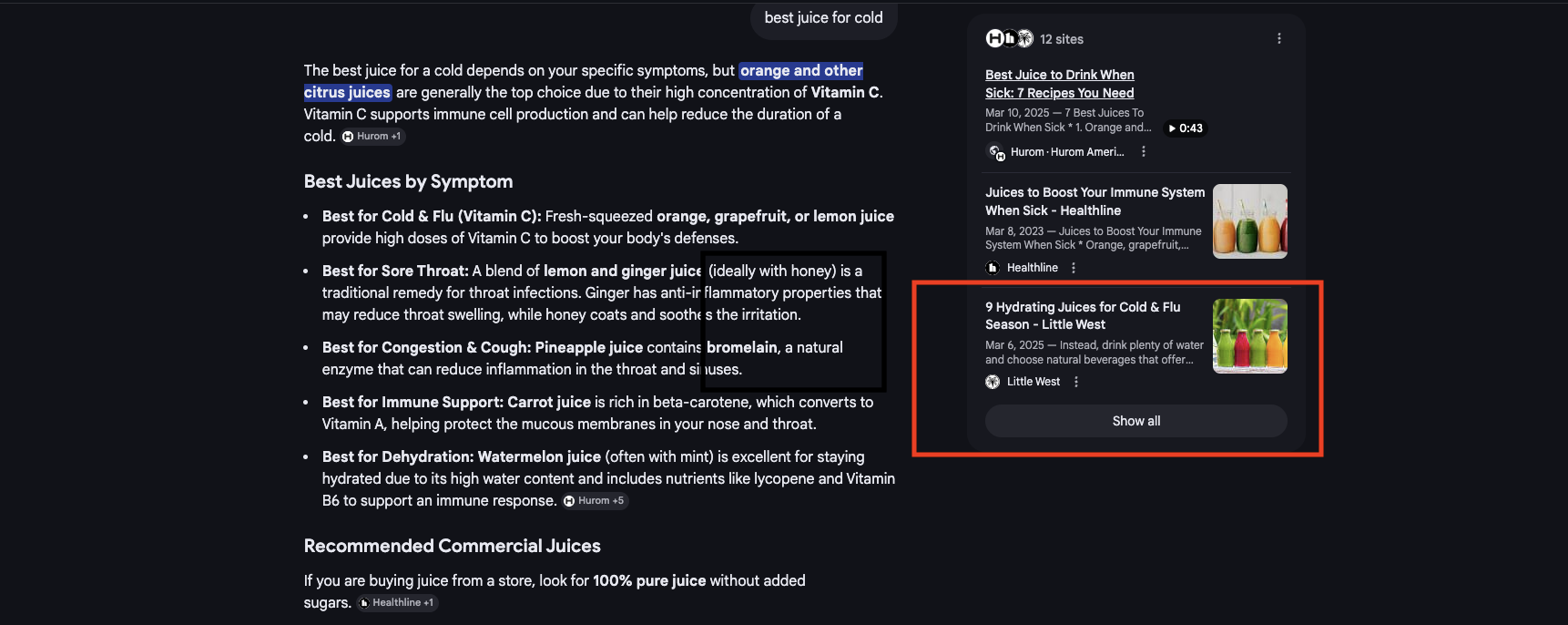
Initial AI Mode Query: “best juice for a cold” — Little West cited in AI Overview (position 2) for their pineapple and ginger juice content.
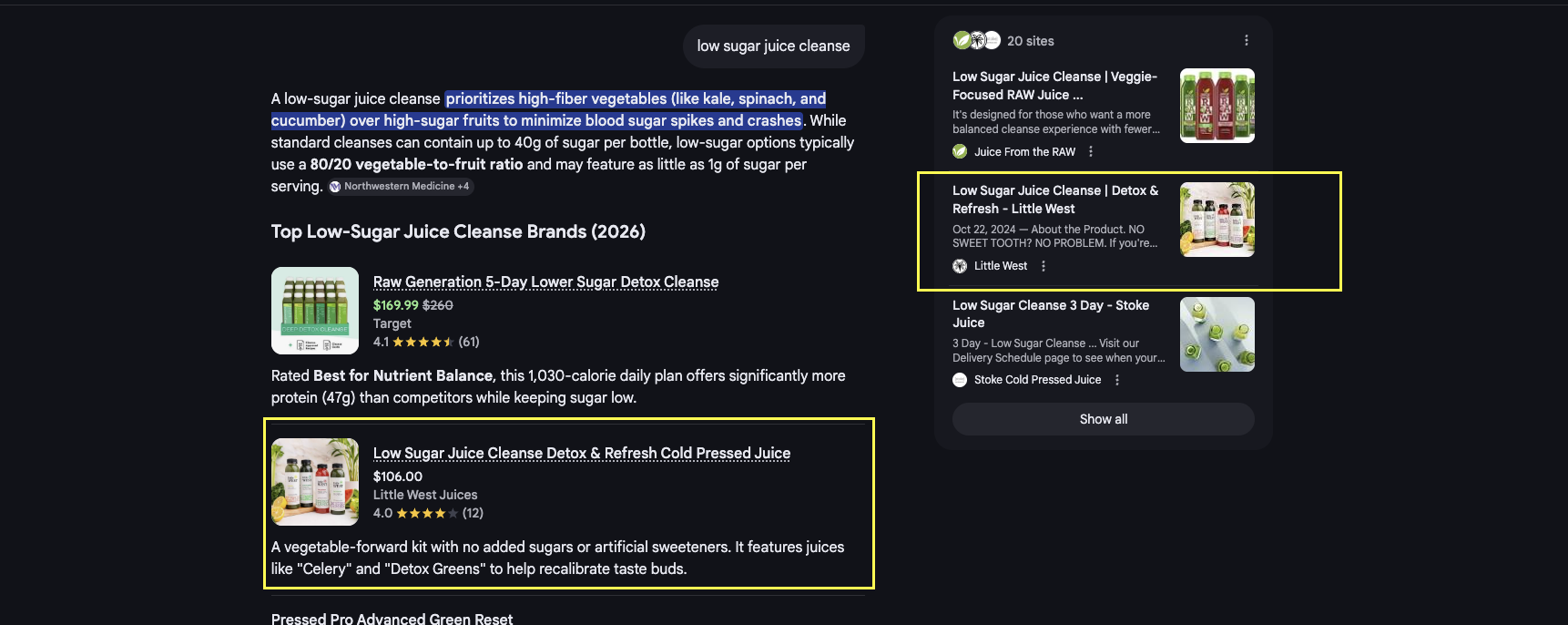
Follow-up in AI Mode: User asks “what about ingredients that boost immunity?” — AI Mode cites Little West’s separate article on ingredient sourcing and immune-boosting vitamins from the same domain.
Third Turn: User asks “how long should I drink this?” — AI Mode again cites Little West’s blog post on optimal juice cleanse timing.
Result: One initial search generated 3 separate citations from the same domain across AI Mode conversation, multiplying impression opportunities 3x vs. AI Overview alone.
5.How To Optimize for AI Overviews (Quick Recap)
While we’re focusing heavily on AI Mode in this article, AI Overviews remain crucial. They appear automatically on the SERP and represent your first impression with hundreds of millions of users daily. Here’s the essentials:
- Answer-first structure: Lead each section with a direct answer before elaborating
- Extractable passages: Aim for 134-167 word paragraphs that can stand alone
- Question-based headings: Use H3s that match user intent as questions
- Schema markup: Deploy FAQ, HowTo, and Article schema to signal answer blocks
- E-E-A-T signals: Demonstrate expertise, experience, authority, and trustworthiness throughout
- Freshness: Regularly update content to show ongoing authority
For a deeper dive on how to rank in AI Overviews and E-E-A-T in the AI search era, refer to our comprehensive resources on content strategy.
6.Strategies That Work for Both
The good news: many optimization tactics benefit both AI Mode and AI Overviews. This means you don’t need two separate content strategies—just a smart unified approach.
| Strategy | AI Mode | AI Overview | Priority |
|---|---|---|---|
| Answer-First Content | ✓ High | ✓ High | Shared |
| Comprehensive Topic Coverage | ✓ High | ✓ Medium | Shared |
| Strong E-E-A-T Signals | ✓ High | ✓ High | Shared |
| Fresh, Updated Content | ✓ High | ✓ High | Shared |
| Multimodal Elements (images, tables) | ✓ High | ✓ Medium | Shared |
| Schema Markup (FAQ, HowTo) | ○ Medium | ✓ High | AI Overview |
| Strategic Internal Linking | ✓ High | ○ Low | AI Mode |
| Topical Clusters | ✓ High | ○ Low | AI Mode |
| Extractable Passages (134-167 words) | ○ Medium | ✓ High | AI Overview |
The Unified Approach
Write content that is both comprehensive (for AI Mode’s multi-turn conversations) and granular (for AI Overview’s extraction). This means:
- Each major section addresses a discrete question and stands alone as extractable content
- Sections are linked together with strong internal linking so AI Mode can traverse the full topic
- Overall word count is substantial (2,000-5,000 words) but broken into digestible chunks
- Schema markup supports both FAQ structure (for AI Overviews) and hierarchical topic structure (for AI Mode)
7.The Transition Flow: AI Overview → AI Mode
Understanding how users move between AI Overview and AI Mode is critical to your optimization strategy. It’s not a one-or-the-other decision—it’s a user journey. When considering how Google’s AI features compare to alternatives, ChatGPT search ranking factors offer useful context, as do Perplexity AI citation models.
The User Journey
A typical interaction flow:
- User searches: “How do I choose a monitor?”
- AI Overview appears: Shows a 150-word summary citing your page and 2-3 competitors
- User sees “AI Mode” button: Beside the AI Overview
- User clicks AI Mode: Full conversational interface opens
- AI Mode draws on same pool: Now it can cite your page again—and different sections for follow-ups
- Multiple impression opportunities: Your domain gets cited in AI Overview AND multiple times in AI Mode conversation
Multiplied Visibility
What’s remarkable is that a single search query can now generate multiple citation opportunities for your content. If your page is cited in the AI Overview and then cited 3-4 times across the AI Mode conversation, you’ve received 4-5 impressions from a single search intent.
AI Overview vs AI Mode Citation Frequency
Little West Performance Metrics:
- AI Overview citations: Average 1-2 citations per SERP for core juice-related queries
- AI Mode citations: Average 3-4 citations per conversation (multiple pages cited across turns)
- Citation persistence: 78% of multi-turn conversations cite the same domain (Little West) 2+ times
- Traffic impact: AI Mode conversations generate 2.5x more qualified traffic than AI Overview alone due to extended engagement
Insight: Topic clusters (pillar pages + subtopic pages) create the multi-citation advantage. AI Mode references different pages, multiplying impressions.
8.What This Means for Your SEO Strategy
The rise of AI Mode fundamentally shifts SEO priorities. Here’s how to adapt your strategy:
Priority 1: Shift From “One Best Page” to “Topic Domination”
Don’t aim for one page to rank. Aim for one page to become the source AI Mode keeps citing across a conversation. This requires comprehensive content, not just the “best” answer. Building this means optimizing with answer-first content formatting strategies.
Priority 2: Build Topic Clusters Over Isolated Pages
A pillar + cluster structure where a central page links to 5-10 subtopic pages, and those subtopics link back, creates a web AI Mode can traverse. This beats having 15 unlinked pages on related topics.
Priority 3: Invest in FAQ and Comparative Content
FAQ-style content that anticipates follow-up questions is gold in AI Mode. Also, comparative content (e.g., “Monitor A vs. Monitor B”) addresses the nuanced follow-ups users ask. This requires proper schema markup strategies for AI Overviews to help Google understand your content structure.
Priority 4: Monitor AI Citations Separately
Track where your content appears in AI Mode conversations separately from AI Overview appearances. The metrics are different, and optimization tactics differ too. Use Google Search Central tools and measure your AI search visibility with dedicated monitoring.
9.Key Takeaways & Action Steps
Here’s what to do right now to optimize for AI Mode while maintaining AI Overview visibility:
5 Immediate Actions
- Audit your top 20 pages for AI Overview citations. Use Google Search Central and manual SERP checks to identify which content is being cited in AI Overviews. Document the exact passages being extracted.
- Identify topic cluster opportunities. Find 3-5 main topic areas where you could build a pillar + 5-10 cluster structure. Map out what content exists and what gaps need filling.
- Rewrite your top 10 underperforming pages for AI Mode. Add sections that anticipate follow-up questions. Expand word count. Improve internal linking to related pages. Test extraction in AI Mode.
- Implement strategic internal linking. Ensure each page in a cluster links to 3-5 related pages and back to the pillar. Use descriptive anchor text.
- Set up AI Mode monitoring in your analytics. Track AI Mode traffic separately if your tool supports it. Monitor citation frequency and conversation depth.
AI Overview & AI Mode Performance Across Clients
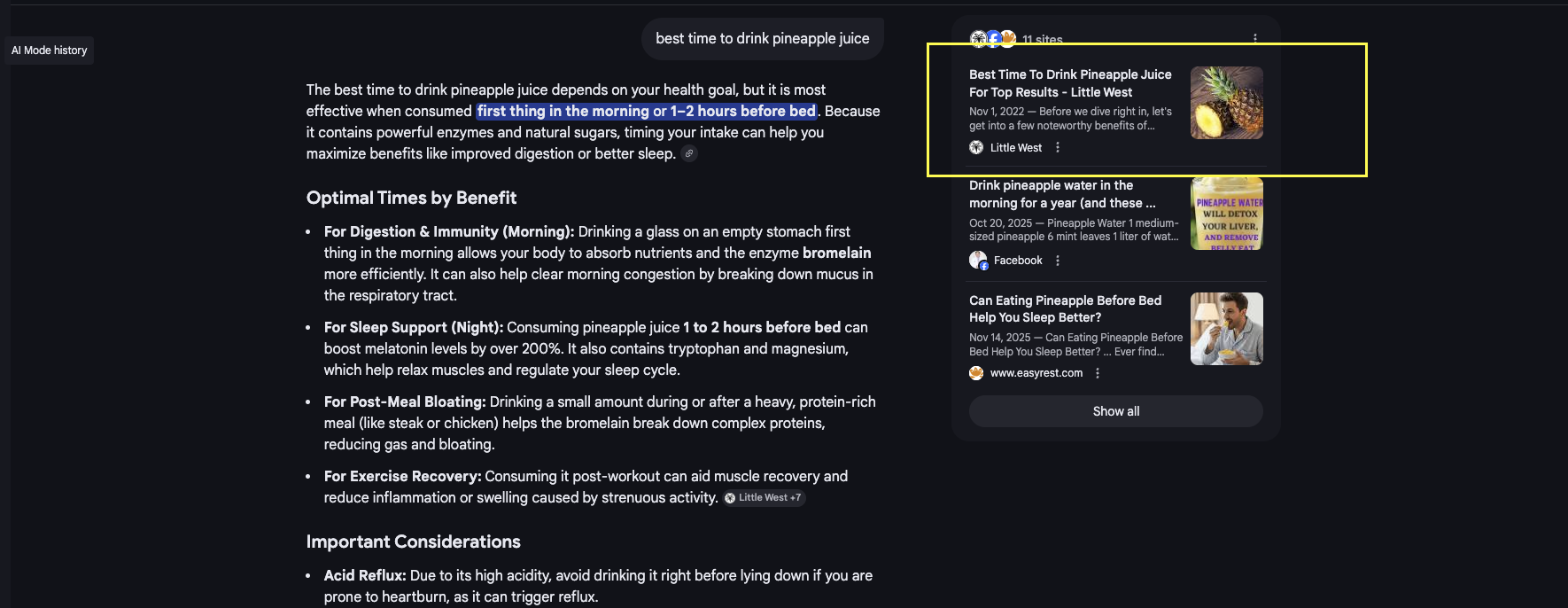
Little West (Juice/Wellness): Appears in AI Overview for 3 core queries (best juice for a cold, best time to drink pineapple juice, can you put frozen fruit in a juicer). Topic cluster structure generates 2-3x more AI Mode citations.
CWSpirits (Ecommerce): Ranks in AI Overview SERP for “best bourbon” (position 10). Category authority with 79K keywords drives consistent AI Mode citations across liquor-related follow-ups.
Vegan Essentials (Category Authority): Appears in AI Overview + Featured Snippet for “vegan foods” (position 6) and “eggs from plants” (position 1). Dominates category queries in AI Mode with 434 keywords in top 3 positions.
Method Lash (Niche Beauty): Appears in AI Overview for “does crying make your eyelashes longer” (position 21, 5.5K volume) and “what is wispy lashes” (position 7, 100 volume). Educational content drives AI citations in long-tail beauty queries.
Pattern: Content that ranks for multiple related queries across AI Overview creates the best multi-turn AI Mode citation opportunities.
Summary: AI Mode Changes the Game
The opportunity: With 2 billion+ users accessing AI Mode, the way search results are generated and cited has fundamentally changed. Instead of competing for a single position in the SERP, you can now compete for multiple citations across an ongoing conversation.
The shift: AI Overviews reward answer-first, extractable content. AI Mode rewards comprehensive, topically-connected content with strong internal linking and topic clusters.
The strategy: Build content that serves both. Write comprehensive pages with clear section structure. Connect them with strategic internal linking. Anticipate follow-up questions in your content planning. Monitor AI Mode citations as a distinct metric.
The result: One search query can now generate 4-5 citation opportunities for your domain instead of 1-2. Your traffic opportunity has multiplied. The SEOs who understand and optimize for AI Mode now will dominate visibility in 2026 and beyond.