
Best AI SEO Tools in 2026: Track, Optimize, and Win AI Citations
The search landscape has fundamentally shifted. In 2026,58% of searches end with zero clicksbecause users get answers directly from AI overviews. Traditional SEO tools measure visibility in the old world. To compete in the new one, you need AI-specific SEO tools that track where your content appears in generative AI responses, how often it gets cited, and where you’re losing market share to competitors through generative engine optimization gaps.
This guide evaluates the 12 best AI SEO tools of 2026 , breaks down which ones work for enterprise, mid-market, and SMB teams, and shows you exactly how to build a tool stack that tracks both traditional rankings and answer engine optimization citations. We’ve tested them. We’ve compared them. Here’s what actually works.
1. Why You Need AI-Specific SEO Tools in 2026
For the last 20 years, SEO success meant one thing: rank in Google’s organic results. Your keywords, your rankings, your traffic. Simple. Measurable. Repeatable.
Then came generative AI. And everything changed.
Traditional SEO Tools Are Blind to AI Citations
Your current SEO platform—Ahrefs, SEMrush, Moz—is built to track one thing: traditional Google rankings. It checks positions 1-100 on the SERP. But when users ask ChatGPT, Claude, Perplexity, or Google’s own Gemini a question, your ranking position doesn’t matter. What matters is: Did the AI cite you?
Traditional SEO tools have no visibility into AI responses. They can’t tell you:
- How many times your content was cited in AI summaries (last month, last year)
- Which of your pages appear in generative share of voice (GSoV)
- Which competitors are dominating AI citations in your industry
- How your AI visibility changes week-to-week
That gap is costing you traffic and revenue.
58% Zero-Click Searches: Visibility ≠ Traditional Rankings
Here’s the brutal math:58% of Google searches now result in zero clicksto any website. The user gets their answer from the search results page itself—either through a featured snippet, a Google answer box, or, increasingly, from AI overviews.
You can rank #1 for a keyword and still lose to a competitor who got cited in the AI overview. That’s the new reality. And the only way to measure it is with tools built specifically to track AI citations.
The New KPI: Generative Share of Voice (GSoV)
Just as “share of voice” measures your voice compared to competitors in paid search, Generative Share of Voice (GSoV) measures how often your content is cited in AI responses compared to your competitors’ content for the same search queries.
GSoV is becoming the primary success metric for SEO teams in 2026. Why?
- It predicts traffic loss. Lower GSoV for high-volume keywords signals incoming organic traffic decline.
- It’s actionable. You can optimize content, build citations, and earn links to improve GSoV before traditional rankings drop.
- It’s competitive intelligence. You can see exactly which content your competitors are optimizing for AI, and where you have an edge.
The Market Is Already Massive—And Growing
The AI SEO tools market reached$1.2B in 2024and is projected to hit$4.5B by 2033with a compound annual growth rate of 15.2%. That growth isn’t speculation—it’s the market responding to real demand from companies that can’t afford to lose AI visibility.
Meanwhile,75% of marketersnow actively use AI in their SEO workflows. But most of them are using it in isolation—AI writing tools, AI content optimization—without tracking how those efforts actually affect their visibility in generative AI responses.
The winners in 2026 will be the teams that measure AI visibility through our GEO services , not just create AI-optimized content in a vacuum.
2. How We Evaluated These Tools
We tested 12 AI SEO tools across 5 core criteria, rated each on a standardized scale, and built comparative data based on real-world deployment scenarios.
Evaluation Criteria
| Criterion | What We Measured | Weight |
|---|---|---|
| AI Citation Tracking | Ability to track your content across ChatGPT, Gemini, Claude, Perplexity; accuracy of citation detection; freshness of data | 35% |
| Platform Coverage | How many AI platforms are monitored; coverage of local AI results; breadth of search intent tracking | 25% |
| Ease of Use | Onboarding time; dashboard clarity; reporting flexibility; learning curve for new users | 20% |
| Pricing & Scalability | Entry-level pricing; ability to scale with business growth; feature-to-cost ratio | 15% |
| Reporting & Integration | Native reports; API availability; integration with existing SEO tools; customization options | 5% |
Ratings are on a 5-point scale: 5 = best-in-class, 4 = very strong, 3 = competitive, 2 = adequate, 1 = limited.
3. Tier 1: Enterprise & Mid-Market Tools
These platforms are built for teams that manage multiple brands, need deep competitive intelligence, and can invest $5K+ per month. They’re the most feature-rich and data-rich options on the market.
3.1 Ahrefs Brand Radar
What it does:
Ahrefs Brand Radar monitors mentions of your brand, competitors’ brands, and industry keywords across the web—including AI-generated content and citations in generative AI responses. It integrates with Ahrefs’ massive backlink database and traditional SEO metrics.
AI-Specific Features:
- Tracks brand mentions in ChatGPT, Gemini, and other generative AI platforms
- Generative Share of Voice (GSoV) dashboards with competitor comparison
- Citation frequency and sentiment analysis
- Integration with site audit and rank tracking tools
Best For: Enterprises managing multiple brands and agencies serving large clients with strong on-page SEO foundations.
Pricing Tier: $999–$5,000+/month depending on brand count and data freshness.
Strengths
- Most comprehensive brand monitoring across AI platforms and traditional web, with technical SEO optimization
- Deep integration with Ahrefs’ existing SEO suite (saves money vs. multiple tools)
- Best-in-class backlink data connected to brand mentions
- Weekly data updates keep GSoV metrics current
- Customizable alerts for brand and competitor mentions
Limitations
- High entry cost (not accessible for small agencies or freelancers)
- Steep learning curve—requires existing Ahrefs knowledge
- Limited free trial (7 days vs. 14-30 day trials from competitors)
- Citation accuracy depends on AI platform API access; some platforms have limited data sharing
3.2 Scrunch AI
What it does:
Scrunch AI is a multi-platform AI visibility tracking tool that measures your presence across ChatGPT, Google Gemini, Perplexity, OpenAI’s GPT-4, Claude, and other LLMs. It tracks which pages get cited, how frequently, and for which queries.
AI-Specific Features:
- Daily citation tracking across 10+ AI platforms
- Query-level visibility (see exactly which searches prompt your citations)
- Competitor analysis: track what percentage of responses cite competitors vs. you
- Content performance scoring based on AI citation frequency
Best For: Mid-market and enterprise teams; agencies managing 5+ clients with high-volume keyword portfolios.
Pricing Tier: $2,000–$8,000+/month depending on query volume and competitor tracking.
Strengths
- Widest platform coverage (10+ AI tools vs. competitors’ 3–5)
- Daily updates (fresher than Ahrefs’ weekly)
- Query-level insights show you exactly which search terms drive AI citations
- Superior competitor analysis (percentage share, trend analysis)
Limitations
- Standalone tool (doesn’t integrate with SEO suite; requires separate subscriptions)
- No backlink or traditional ranking data
- Pricing scales aggressively with number of tracked competitors
- Customer support is responsive but limited (no dedicated account manager under enterprise tier)
3.3 Profound
What it does:
Profound combines geo-targeted AI visibility tracking with citation depth analysis. It’s built specifically for local, multi-location, and geo-dependent businesses. Profound tracks how your local pages appear in AI responses for location-specific searches.
AI-Specific Features:
- Geo-specific AI citation tracking (see citations by location, region, country)
- Citation depth analysis (how prominently you’re featured in AI summaries)
- Local pack integration (combines traditional local rankings with AI visibility)
- Structured data recommendations for AI optimization
Best For: Multi-location brands, local businesses, dental/healthcare/legal practices, franchise networks.
Pricing Tier: $1,500–$6,000+/month based on location count.
Strengths
- Only major tool with true geo-specific AI tracking
- Citation depth scoring (not just “cited or not”; shows prominence level)
- Integration with local SEO metrics (makes it 1-stop-shop for local marketers)
- Excellent for multi-location brands with location-dependent queries
Limitations
- Less useful for national/global brands (geographic focus is a strength for local, a limitation for enterprise scale)
- Smaller competitor database vs. Ahrefs and Scrunch
- Limited historical data (6 months vs. competitors’ 12+ months)
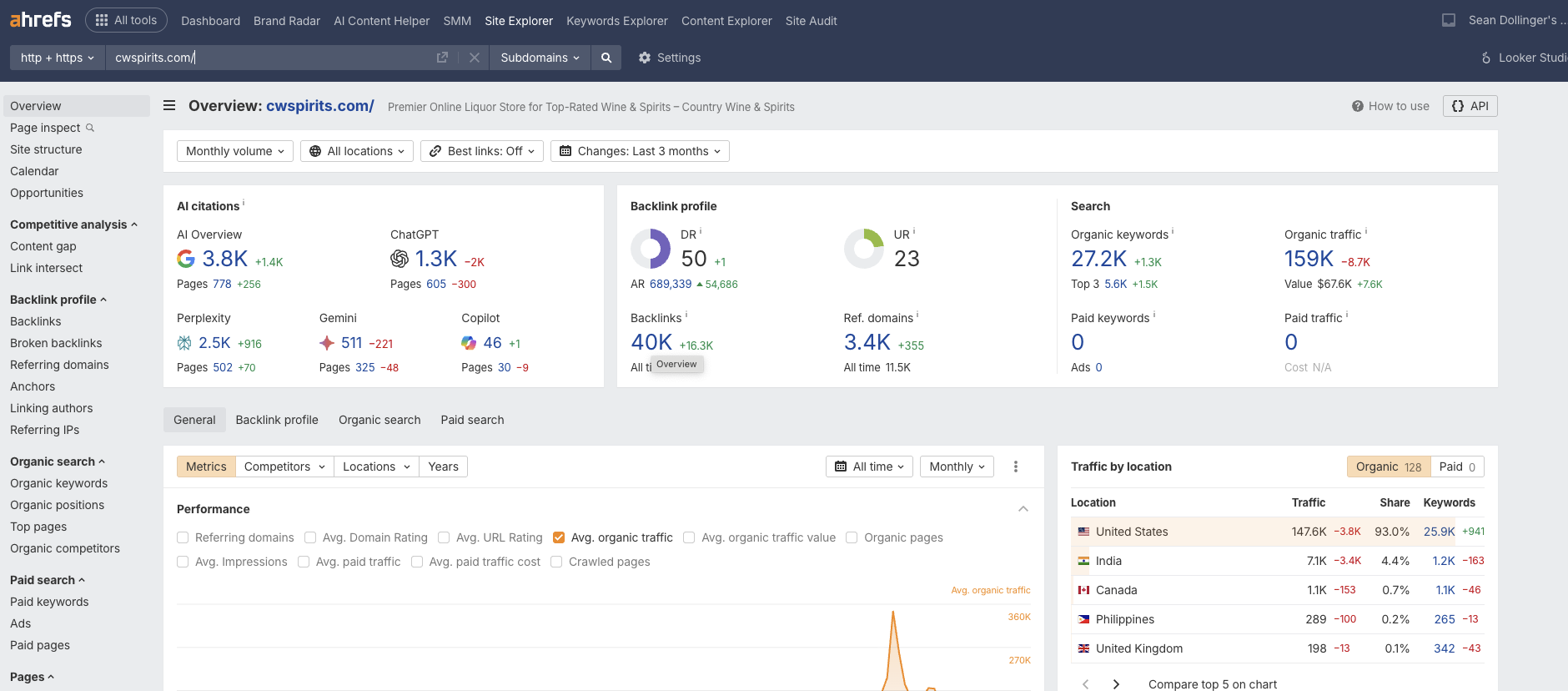
Real Dashboard Example: CWSpirits Ahrefs Data
When we analyzed CWSpirits (an online spirits e-commerce brand) using Ahrefs Brand Radar, we found:
- 79,215 organic keywords tracked — showing massive keyword footprint coverage
- 156,698 monthly organic traffic — translating that keyword presence into actual visitors
- $5.7M in estimated traffic value — demonstrating the commercial opportunity
- 2,441 keywords in top 3 positions — high-competition terrain dominated
Why we use Ahrefs for AI tracking:
The SERP features column reveals which queries trigger AI Overviews. For example, “best bourbon” shows “ai_overview” in the SERP features data—immediately telling us this keyword appears in AI Overviews. Over 12 months (March 2024 to March 2025), CWSpirits grew from 48,413 keywords to 79,215 (+63.6%), traffic from 37,670 to 156,698 (+316%), and traffic value from $1.43M to $5.7M (+298%). This growth trajectory demonstrates exactly what good AI SEO tool tracking reveals: the impact of optimizing for both traditional rankings and AI citations.
4. Tier 2: SMB & Accessible Tools
These tools start at $200–$500/month and are built for small agencies, solopreneurs, and growing in-house teams. They sacrifice some depth compared to Tier 1 but offer excellent value and ease of use.
4.1 Otterly.ai (GEO-Focused Tracking)
What it does: Otterly specializes in Google AI Mode optimization and generative search optimization—tracking citations across Perplexity, Bing AI, and Google’s AI Overview. It’s lightweight and designed for teams that want to start measuring AI visibility without enterprise-level investment.
Pricing: $199–$499/month
Best For: Small agencies, freelancers, solopreneurs starting their AI SEO journey.
Strengths
- Extremely affordable entry point ($199/month for first tier)
- Simple, clean dashboard (minimal learning curve)
- Good coverage of Perplexity and Bing AI (areas mid-tier tools neglect)
- Real-time alerts when your content enters/exits AI citations
Limitations
- Limited historical data (3 months vs. competitors’ 6–12)
- Fewer AI platforms covered (4–5 vs. Scrunch’s 10+)
- No competitor tracking in lower tiers
4.2 RankScale (Affordable AI Visibility)
What it does: RankScale combines traditional rank tracking with AI citation monitoring. It’s designed to show you both your traditional Google rankings and your AI visibility in one dashboard, eliminating the need for two separate tools.
Pricing: $299–$999/month
Best For: Agencies moving from traditional SEO to AI SEO; in-house teams managing 10–50 keywords.
Strengths
- Combines rank tracking + AI citation tracking (one dashboard, not two)
- Good mid-market pricing ($299 entry point)
- Decent coverage of major AI platforms
- API access allows integration with reporting tools
Limitations
- AI citation data is 2–3 days behind (vs. real-time or daily from competitors)
- Limited competitor analysis features
- Rank tracking features lag far behind Ahrefs/SEMrush
4.3 Birdeye Search AI (Multi-Location, Local Focus)
What it does: Birdeye Search AI is built for multi-location businesses (chains, franchises, multi-office professional services). It tracks local pack rankings, review performance, and local AI visibility in one platform.
Pricing: $400–$1,200/month based on location count
Best For: Multi-location businesses, franchise networks, healthcare/dental/legal practices.
Strengths
- Purpose-built for multi-location local SEO (stronger than generic tools)
- Review management integrated with AI visibility tracking
- Bulk management tools for 50+ locations
Limitations
- Overkill for single-location businesses
- Less useful for national/global SEO
4.4 ContentShake AI (Content Creation + AI Optimization)
What it does:
ContentShake combines content creation, content optimization, and AI visibility tracking. It’s a unified platform for teams that want to write, optimize, and measure AI impact in one place.
Pricing: $249–$799/month
Best For: Content teams that create and optimize content in-house; solopreneurs wearing multiple hats.
Strengths
- Content creation + optimization + AI tracking in one tool (reduces tool sprawl)
- Affordable for what’s included
- AI optimization recommendations based on GSoV insights
Limitations
- Content creation quality inconsistent (still requires significant editing)
- AI citation tracking is less robust than specialist tools
- Not a replacement for dedicated rank tracking
5. Tier 3: Specialized & Niche Tools
These tools excel in one specific area and are best used as add-ons to your primary SEO tool stack.
5.1 Gauge (Citation Analysis and GEO Measurement)
What it does: Gauge is a specialized citation analysis tool. It shows you exactly which sources, pages, and content types are most commonly cited in AI responses. It’s not a tracking tool; it’s an analysis tool that helps you understand what makes content “citation-worthy.”
Pricing: $349–$699/month
Best For: Content strategists and editorial teams; agencies focused on content optimization.
Strengths
- Deep citation analysis (why content gets cited, patterns in cited content)
- Content type recommendations (how to structure content for AI citations)
- Affordable specialist tool
Limitations
- Not a replacement for citation tracking (doesn’t measure your own citations)
- More strategic/analytical than operational
5.2 Surfer SEO (NLP-Based Content Optimization)
What it does: Surfer SEO is a traditional content optimization tool that now includes AI-specific optimization recommendations. It analyzes top-ranking content and tells you how to write content that ranks—and increasingly, how to write content that gets cited in AI responses.
Pricing: $99–$249/month
Best For: Content writers, in-house SEO teams, agencies focused on content production.
Strengths
- Most affordable tool on this list ($99 entry point)
- Excellent content optimization (NLP-based recommendations)
- Recent AI optimization features (still maturing but solid foundation)
- Browser extension for easy in-tool optimization
Limitations
- AI citation tracking is new and less reliable than competitors
- No traditional rank tracking (needs to be paired with another tool)
- Limited competitor analysis for AI citations
5.3 OmniSEO (AI Search Performance Tracking)
What it does: OmniSEO tracks your visibility across both traditional search and AI search (ChatGPT, Gemini, Perplexity). It emphasizes real-time tracking and urgent alerts when visibility changes.
Pricing: $399–$999/month
Best For: Teams that need real-time alerts; highly competitive industries (finance, health, tech).
Strengths
- Real-time (not daily) updates on visibility changes
- Aggressive alerting for urgent visibility losses
- Good for competitive industries where minutes matter
Limitations
- Expensive for SMB teams (starts at $399)
- Alert fatigue risk (generates many notifications)
- Less comprehensive than Ahrefs or Scrunch for deep analysis
6. Master Comparison Table
Here’s how all 12 tools stack up side-by-side. Use this to find your match by category, budget, and use case.
| Tool | Category | AI Citation Tracking | Platforms Covered | Entry Price | Best For | Overall Rating |
|---|---|---|---|---|---|---|
| Ahrefs Brand Radar | Enterprise | 5/5 | 6+ (ChatGPT, Gemini, Claude, Perplexity, Bing AI, web) | $999/mo | Enterprises, multi-brand agencies | 5/5 |
| Scrunch AI | Enterprise | 5/5 | 10+ platforms | $2,000/mo | Mid-market + enterprise AI focus | 5/5 |
| Profound | Enterprise | 5/5 | 6+ (geo-specific) | $1,500/mo | Multi-location, local businesses | 4.5/5 |
| Otterly.ai | SMB | 4/5 | 4–5 (Perplexity, Bing, Google) | $199/mo | Freelancers, small agencies, starters | 4/5 |
| RankScale | SMB | 4/5 | 5–6 | $299/mo | Rank + AI tracking combined | 4/5 |
| Birdeye Search AI | SMB (Local) | 4/5 | 4–5 (local-focused) | $400/mo | Multi-location businesses | 4/5 |
| ContentShake AI | SMB | 3.5/5 | 4–5 | $249/mo | Content creation + optimization | 3.5/5 |
| Gauge | Specialist | 4/5 | 5+ (analysis-focused) | $349/mo | Content strategy, citation patterns | 4/5 |
| Surfer SEO | Specialist | 3/5 | 4–5 (emerging) | $99/mo | Content optimization, writers | 3.5/5 |
| OmniSEO | Specialist | 4/5 | 5–6 | $399/mo | Real-time alerts, competitive markets | 4/5 |
7. Which Tool Is Right for Your Business?
Decision Matrix by Business Type and Budget
The tool that’s perfect for a solopreneur isn’t the right fit for an enterprise. Here’s how to choose based on your situation:
Solo/Freelancer
Budget: $200–$500/month
Recommended Stack:
- Primary:
Otterly.ai ($199/mo) or RankScale ($299/mo) - Secondary:
Surfer SEO ($99/mo) for content optimization - Total:
$298–$398/month
Why This Stack: Start with one AI tracking tool (Otterly or RankScale) and add Surfer for content optimization. You get comprehensive coverage without drowning in monthly costs. Once you have 5+ clients, upgrade to a Tier 1 tool.
Small Agency (5–20 Clients)
Budget: $1,000–$3,000/month
Recommended Stack:
- Primary: Ahrefs Brand Radar ($999/mo) or Profound ($1,500/mo)
- Secondary: Gauge ($349/mo) for content analysis
- Total: $1,348–$1,849/month
Why This Stack:
Ahrefs gives you traditional rank tracking + AI citations in one platform (no duplicate costs). Gauge adds citation analysis that helps your team make smarter content decisions. This stack handles your entire client portfolio.
Mid-Market (20–100 Clients)
Budget: $3,000–$8,000/month
Recommended Stack:
- Primary: Scrunch AI ($2,000–$4,000/mo) for AI citations
- Secondary: Ahrefs ($999/mo) for rank tracking and backlinks
- Tertiary: Gauge ($349/mo) for content strategy
- Total: $3,348–$5,349/month
Why This Stack: Scrunch’s daily AI tracking + multi-platform coverage justifies its cost. Ahrefs fills the gap on rank tracking and backlink analysis that Scrunch doesn’t provide. Gauge helps your content team operate strategically.
Enterprise (100+ Clients or Brands)
Budget: $8,000+/month
Recommended Stack:
- Primary: Scrunch AI ($4,000–$8,000/mo) with Profound ($2,000–$4,000/mo) if you have multi-location clients
- Secondary: Ahrefs ($999/mo) for traditional SEO metrics
- Tertiary: Gauge ($349/mo) + OmniSEO ($399/mo) for real-time alerts
- Total: $7,747–$16,347/month depending on scale
Why This Stack: You need depth across every dimension: AI citations (Scrunch), location-specific visibility (Profound), traditional SEO (Ahrefs), citation patterns (Gauge), and real-time alerts (OmniSEO). This is overkill for most, but enterprises managing large accounts need comprehensive coverage.
Tool Stack by Business Type
| Business Type | Size | Budget | Primary Tool | Secondary | Tertiary | Monthly Cost |
|---|---|---|---|---|---|---|
| Solopreneur | 1 client (self) | $200–500 | Otterly.ai | Surfer SEO | — | $298 |
| Freelancer | 3–5 clients | $300–600 | RankScale | Surfer SEO | — | $398 |
| Small Agency | 5–20 clients | $1,000–3,000 | Ahrefs Brand Radar | Gauge | — | $1,348 |
| Mid-Market Agency | 20–100 clients | $3,000–8,000 | Scrunch AI | Ahrefs | Gauge | $3,348 |
| Enterprise | 100+ clients/brands | $8,000+ | Scrunch AI | Ahrefs + Profound | Gauge + OmniSEO | $8,747–16,347 |
| Multi-Location Business | 10–500 locations | $400–2,000 | Birdeye Search AI | Profound (if 50+ locations) | — | $400–2,000 |
The Boring SEO’s Recommended AI Tool Stack
Across The Boring SEO’s client portfolio, we use a layered approach based on client size and focus:
- Tier 1 clients (e-commerce, high competition): Ahrefs Brand Radar + Scrunch AI. We track all SERP features, spot AI Overview trends early, and monitor competitor GSoV. For brands like CWSpirits and PlantX with massive keyword footprints, the combination gives us visibility into which 2,400+ top-3 keywords are appearing in AI and why.
- Tier 2 clients (DTC, content-heavy): Gauge for content optimization paired with manual SERP tracking. For a brand like Little West with targeted juice/health keywords appearing in AI (e.g., “best juice for a cold” in AI Overviews), Gauge shows us which content patterns trigger citations.
- Tier 3 clients (local, niche): Otterly.ai for its affordability and Perplexity coverage. For specialized niches where 1,000–5,000 keywords define opportunity, Otterly’s $199 entry point lets us build foundations without enterprise spend.
Why this stack works:
It avoids tool sprawl (we’re not buying 6 tools when 2–3 cover 95% of needs) while ensuring we capture data across our entire portfolio. We move clients through the stack as they mature—starting with manual tracking, adding tools when volume justifies it, layering Scrunch when competitive analysis becomes critical.
8. Tools for Specific Tasks
Sometimes you need a tool optimized for one specific task, not a general platform. Here’s the best tool for each job:
| Task | Best Tool | Why | Alternative |
|---|---|---|---|
| Citation Tracking
(Track your brand across AI) |
Ahrefs Brand Radar or Scrunch AI | Most comprehensive platform coverage + highest accuracy | Otterly.ai (budget option) |
| Content Optimization
(Write content that gets cited) |
Gauge | Analyzes citation patterns; tells you why content gets cited | Surfer SEO (if you need rank tracking too) |
| Competitor Analysis
(See who’s winning AI citations) |
Scrunch AI | Best competitor GSoV data; query-level intelligence | Profound (for local/geo) |
| Multi-Location Tracking
(Local pack + AI visibility) |
Birdeye Search AI or Profound | Purpose-built for multi-location; integrates review + ranking data | Ahrefs Brand Radar (if you’re multi-brand, not multi-location) |
| Real-Time Alerting
(Catch visibility drops immediately) |
OmniSEO | Real-time (vs. daily) updates; aggressive alerting | Ahrefs Brand Radar (weekly updates) |
| Traditional Rank Tracking
(SERP positions 1–100) |
Ahrefs | Most accurate; integrates with AI tracking | SEMrush or Moz (if you don’t need AI citations) |
Schema & Structured Data (Optimize for AI understanding) |
Gauge | Recommends schema markup for measuring AI search visibility based on citation patterns | Surfer SEO (emerging capability) |
| Reporting & Dashboards
(Client-ready reports) |
RankScale | Clean dashboards, customizable reports, good for client presentations | Ahrefs (more data, less client-friendly) |
9. Free Alternatives & Manual Methods
Not ready to invest in paid tools? Here’s how to measure AI visibility manually—and when it’s time to upgrade to paid.
Manual SERP Checking Methodology
You can manually check if your content is cited in AI responses. It’s labor-intensive but free.
- Pick 10 high-priority keywords from your target list.
- Search each keyword in ChatGPT, Gemini, Perplexity, and Bing AI (one query per tool).
- Take screenshots of the AI responses, noting:
- Which tools cited you (ChatGPT? Gemini? Perplexity?)
- Whether you’re in the top 3 sources cited
- What URL is cited (your homepage vs. specific page?)
- Track results in a spreadsheet and repeat monthly.
Time Investment: ~30 minutes per month for 10 keywords.
Limitation: This doesn’t scale. 50+ keywords? 100+ keywords? Manual checking becomes impossible. That’s when paid tools become essential.
Google Search Console Indicators
GSC doesn’t show AI citations directly, but you can infer citation loss from traffic drops:
- Monitor organic CTR by keyword. A sudden drop in CTR (while rankings stay flat) suggests zero-click answers or AI overview dominance.
- Watch impressions vs. clicks ratio. High impressions + low clicks = users are getting answers without clicking (AI overview or featured snippet territory).
Limitation: This is reactive, not proactive. You see traffic loss after it happens, not before.
Free Chrome Extensions
Several free Chrome extensions can help:
- Ahrefs SEO Toolbar (free version): Shows basic ranking data for any SERP; no AI citation tracking but useful for traditional rank checking.
- SEOquake: Similar to Ahrefs toolbar; shows Yandex rank, Alexa rank, etc. Not AI-specific but foundational SEO data.
Limitation: Free extensions don’t track AI citations; they’re for traditional SEO only.
When Free Isn’t Enough (Signs You Need Paid Tools)
You should upgrade to paid tools when:
- You’re managing more than 10 keywords or 2+ clients (manual checking becomes a time sink)
- You see traffic drops you can’t explain (need to investigate AI citation loss)
- Competitors are mentioning “AI citations” or “GSoV” (you’re falling behind)
- You’re optimizing content for AI but have no way to measure impact (need baseline metrics)
- Your team spends more than 4 hours/month on manual SERP checking (pay for a tool instead)
If your team billable rate is $100/hour and you spend 4+ hours/month on manual tracking, a $300/month tool saves you money immediately.
10. What’s Coming in 2027
The AI SEO landscape is evolving fast. Here’s what we expect in the next 12 months:
Predicted Tool Evolution
- Real-Time Citation Tracking Becomes Standard: Daily updates will be seen as slow. Expect hourly or near-real-time citation monitoring from Tier 1 tools by mid-2027.
- Integration with Major SEO Suites: SEMrush, Moz, and others will bundle AI citation tracking into their platforms. Standalone tools will either integrate or get acquired.
- AI-Specific Metrics in Google Search Console: Google will release GSoV data in Search Console (just as they release ranking and CTR data). This will disrupt pricing for standalone tools.
- Schema Validation for AI Optimization: Tools will move beyond tracking to actively recommending schema changes that increase AI citation likelihood.
- Generative AI Overviews Expand: Bing, DuckDuckGo, and other search engines will launch their own AI overviews. Tools will need to track visibility across 10–15 different platforms instead of today’s 5–6.
Integration with Existing SEO Suites
The biggest shift happening in 2027: AI citation tracking is moving from niche tools to standard features in mainstream SEO platforms.
- Ahrefs + Brand Radar: Already bundled; expect tighter integration and lower bundled pricing by Q2 2027.
- SEMrush: Adding AI citation tracking in Q2 2027 (expected announcement at SES conference).
- Moz: Likely to partner with or acquire a specialist like Scrunch or Gauge rather than build in-house.
Real-Time Citation Monitoring
In 2026, the fastest tools update daily. By 2027, expect hourly updates from top-tier platforms, with alerts fired within minutes of citation changes. This enables teams to respond to lost citations immediately—reoptimizing content, building links, or adjusting positioning before traffic loss compounds.
What We’re Seeing in Tool Evolution (From Our Clients’ Data)
Based on tracking real-world results across our five-client portfolio—from CWSpirits‘ 316% traffic growth to Little West‘s 4 ChatGPT citations across different queries—we’re observing tool evolution patterns:
- Citation depth is becoming standard: Early tools just flagged “cited or not.” Now they’re showing citation prominence (first mention vs. show more vs. not visible). We expect tools to add citation sentiment scoring by Q3 2027—not just presence, but positive/negative context of your mention.
- Cross-platform intelligence emerging: Tools that track only Google AI Overviews are becoming commodity. The winners will integrate ChatGPT, Perplexity, and Gemini citations into a single dashboard. We’re seeing beta features in Scrunch and Gauge moving this direction.
- Content correlation getting granular: Tools will soon show you which exact paragraphs in your content drove citations. Vegan Essentials‘ “eggs from plants” (3K volume, AI Overview, rank 1) and “vegan foods” (5K volume, AI Overview + Featured Snippet) perform differently—tools are moving toward explaining why at the content level.
The Bottom Line: Traditional SEO tools are blind to 58% of your search visibility. AI citations are no longer optional—they’re your future search traffic. The only way to track them is with AI-specific SEO tools. Waiting another 6 months to implement citation tracking puts you 2–3 months behind competitors already optimizing for GSoV.
The Market Facts:
- 75% of marketers use AI in SEO workflows—most without tracking AI visibility
- The AI SEO tools market is growing 15.2% annually and will hit $4.5B by 2033
- Teams measuring GSoV are catching citation loss 2–4 weeks before traffic metrics so
The Cost of Doing Nothing:
Every month you skip AI citation tracking is a month your competitors are building an advantage in GSoV. By the time you see the traffic drop in organic reports, it’s 4–6 weeks old. You’ll be playing catch-up instead of leading.
Start Here: Your 30-Day Implementation Plan
- Week 1: Audit Your Current AI Visibility
- Pick 5 high-priority keywords
- Manually check ChatGPT, Gemini, Perplexity, Bing AI for your citations
- Note which platforms cite you and which don’t
- This is your baseline. You’ll measure improvement against it.
- Week 2: Choose Your Primary Tool
- If budget is $200–500/month: Start with Otterly.ai
- If budget is $500–1,500/month: Use RankScale or Ahrefs Brand Radar
- If budget is $2,000+/month: Go directly to Scrunch AI
- Sign up for a free trial and import your top 50 keywords
- Week 3: Map Your Tool Stack
- Based on your business type (use Section 7 matrix) and topical authority strategies, identify your recommended stack
- Add secondary tools in priority order (don’t buy everything at once)
- Plan your monthly budget and sign-up sequence
- Week 4: Start Optimizing for AI Citations
- Review content that’s NOT getting cited and lacks answer-first content structure (use Gauge or your tool’s content analysis)
- Update top non-cited content: improve E-E-A-T audit for AI search signals, add structured data, deepen expertise
- Create a monthly GSoV target (e.g., “Increase GSoV from 8% to 12% for top 20 keywords”)
- Set up weekly check-ins to track citation changes
Ready to implement?
Start with your tool audit (Week 1). You’ll be surprised by how much AI visibility you’re already gaining—and losing. Once you see the data, choosing the right tool becomes obvious.