
What Is Generative Engine Optimization?
The complete guide to optimizing your content for AI-powered search engines in 2026 — including the 7 ranking signals that drive citations in ChatGPT, Perplexity, Google AI Overviews, and beyond.
Table of Contents
- What Is Generative Engine Optimization (GEO)?
- How Does GEO Work? (The Technical Foundation)
- GEO vs SEO vs AEO: Understanding the Differences
- The 7 Core Ranking Signals for Generative Engine Optimization
- How To Implement GEO: Step-by-Step Framework
- GEO for Different Business Types
- Common GEO Mistakes to Avoid
- The Future of GEO: What’s Coming Next
- Key Takeaways & Next Steps
1.What Is Generative Engine Optimization (GEO)?
Generative Engine Optimization (GEO) is the practice of optimizing your content to be selected and cited by AI-powered search engines. Instead of focusing on traditional rankings, GEO targets the sources that AI language models use to generate search results — making your content visible in ChatGPT responses, Google AI Overviews, Perplexity answers, Claude responses, and other generative AI interfaces.
Think of it this way: In traditional SEO, you compete to rank #1 for a keyword. In GEO, you compete to be cited as a source when an AI answers that question. A user may never click through to your site from a Google search result, but they’ll see your brand, your data, and your insights directly in the AI’s response.
Why GEO Emerged: The Shift from Ranking to Citation
For 25+ years, SEO meant one thing: rank higher than your competitors for your target keyword. Google’s algorithm valued links, content quality, and relevance — and you won if you appeared on page one.
But generative AI fundamentally changed how answers are delivered. Now, Google’s AI Overview (launched March 2024) pulls from multiple sources and synthesizes an answer. ChatGPT does the same. Perplexity does the same. The user gets a complete answer without leaving the search interface — and your content’s value lies in being cited within that synthesized response.
This shift has three consequences:
- Citation matters more than ranking. Being #1 for a keyword doesn’t guarantee citation. Being cited does.
- Content structure changes. AI models prefer clear, structured, answer-first content — not keyword-optimized long-form.
- Semantic completeness replaces keyword density. AI models cite sources that comprehensively answer the question, not sources that mention the keyword most.
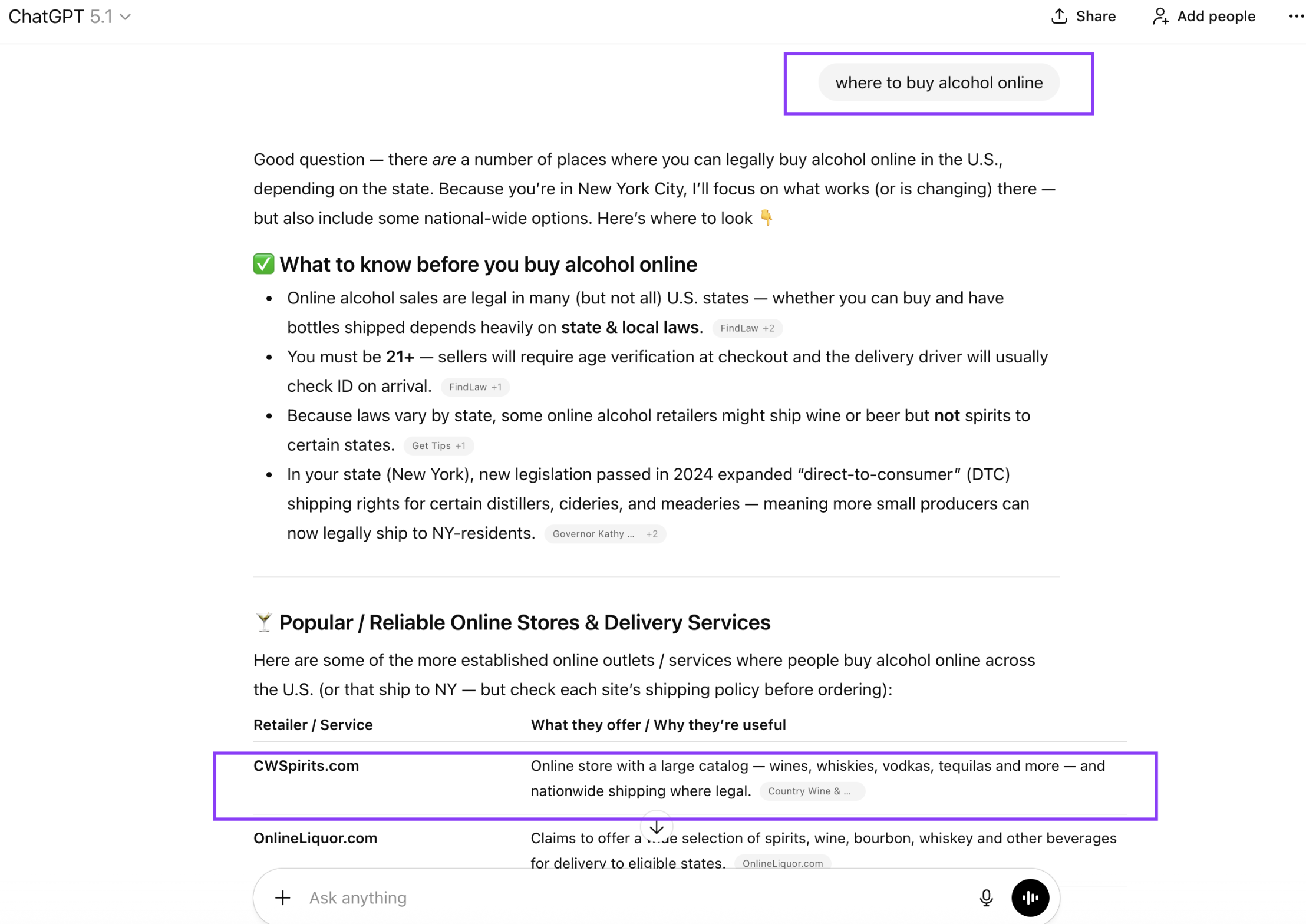
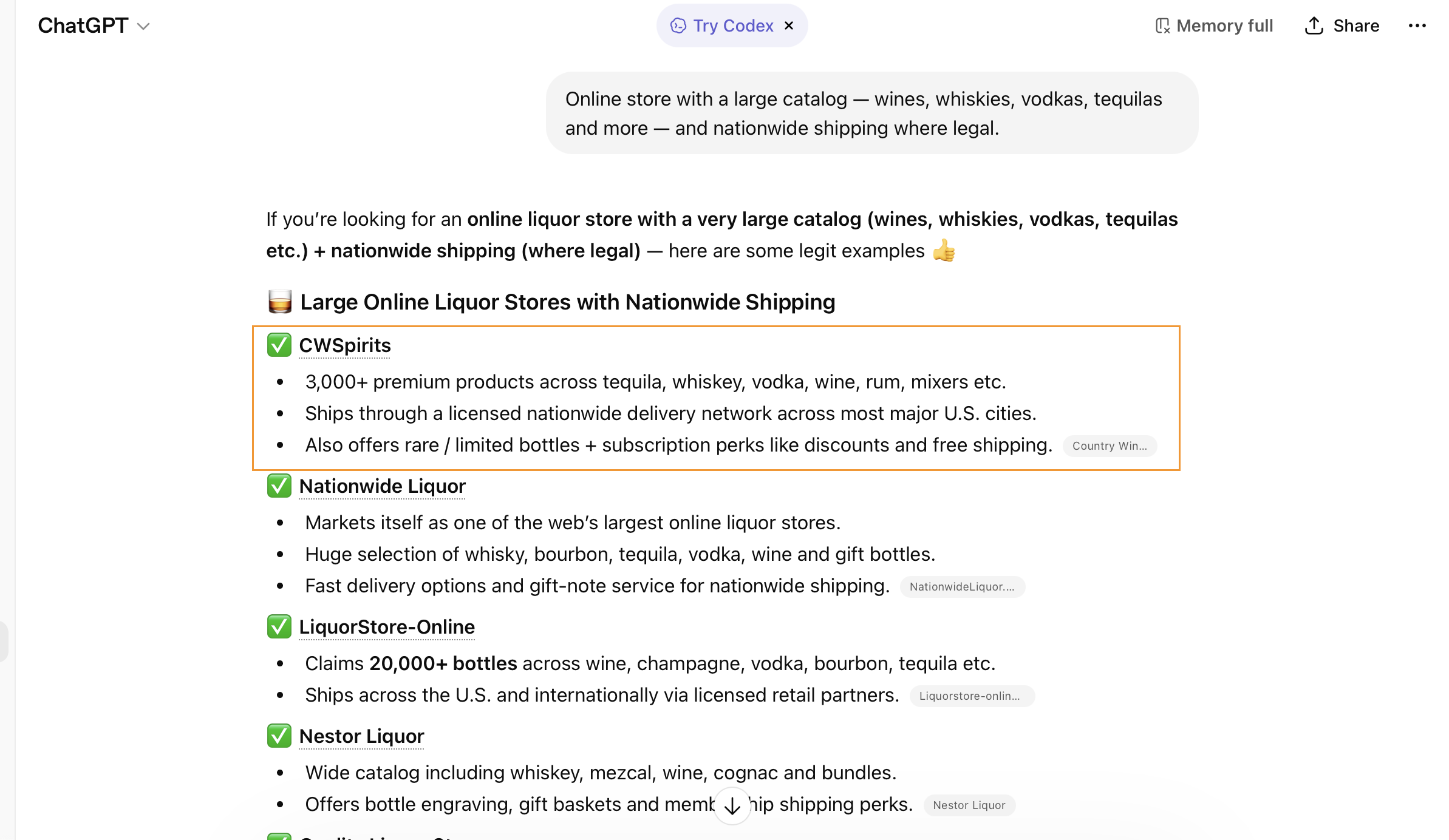
🎯 REAL CLIENT EXAMPLE: CWSPIRITS
ChatGPT 5.1 Citation for “where to buy alcohol online”
CWSpirits.com appears as the top retailer in ChatGPT’s response table, described as: “Online store with a large catalog — wines, whiskies, vodkas, tequilas and more — and nationwide shipping where legal.” This citation drives qualified traffic and positions the brand as the authoritative answer for commercial alcohol queries.
GEO is not a replacement for SEO — it’s an evolution. Your content still needs to rank well to be available for AI models to cite, but ranking alone won’t guarantee citation. You need both traditional SEO fundamentals AND GEO-specific optimizations.
2.How Does GEO Work? (The Technical Foundation)
To optimize for GEO, you need to understand how AI models actually select sources. The process is called Retrieval-Augmented Generation (RAG), and it works in four steps:
The Retrieval → Evaluation → Synthesis → Citation Pipeline
Step 1: Retrieval (Finding Your Content)
When a user asks a question, the AI system performs a semantic search across available content. It doesn’t just look for keyword matches — it finds content that is semantically related to the query. For this to work, your content must be indexable and semantically discoverable (more on this later).
Step 2: Evaluation (Ranking Retrieved Sources)
The AI model then evaluates which sources are most relevant, accurate, and authoritative. This is where the 7 ranking signals (detailed in Section 4) come into play. Content that demonstrates semantic completeness, E-E-A-T, and factual accuracy ranks higher in the AI’s evaluation process.
Step 3: Synthesis (Creating the Response)
The AI synthesizes a response by pulling insights, data, and quotes from the top-evaluated sources. This is where you want your content to appear — not buried in the middle, but among the primary sources used to construct the final answer.
Step 4: Citation (Getting Your Brand Visible)
Finally, the AI cites the sources it used. Your brand name, URL, and snippet appear alongside your attributed content — giving you visibility directly in the AI’s response.
Why GEO Is Different from Traditional Crawl-Index-Rank
Traditional SEO relies on Google’s algorithm, which uses links, keywords, and click-through data to determine relevance and authority. GEO, by contrast, relies on the AI model’s own evaluation of semantic meaning, comprehensiveness, and factual accuracy.
This means:
- Backlinks matter less. An AI model doesn’t care how many sites link to you — it cares whether your content comprehensively answers the question.
- Content depth matters more. You need 134-167 word passages that directly answer sub-questions, not just keyword mentions.
- Multimodal content matters. AI models increasingly cite sources with images, tables, and structured data — not just text.
- Author credentials matter more. AI models check for verified E-E-A-T signals (author bio, credentials, cited sources) to evaluate reliability.
97% of AI Overview citations come from the top 20 traditional rankings (Ahrefs, November 2025). This means you still need SEO fundamentals, but you also need to optimize those top-20 pages for GEO signals.
3.GEO vs SEO vs AEO: Understanding the Differences
Three optimization frameworks are competing for your attention in 2026. Understanding the differences helps you allocate resources strategically.
| Aspect | SEO | GEO | AEO |
|---|---|---|---|
| Goal | Rank #1 in search results | Be cited in AI responses | Answer voice queries accurately |
| How It Works | Google ranks pages based on authority, relevance, technical health | AI models select sources based on semantic completeness and E-E-A-T | Voice assistants match conversational queries to pages |
| Key Signals | Backlinks, content quality, page speed, keywords, core vitals | Semantic completeness, answer-first structure, multimodal content, author credentials | Featured snippet optimization, question/answer format, natural language |
| Timeframe | 3-6 months to see results | 2-4 weeks (faster than traditional SEO) | Immediate (voice indexing is real-time) |
| Primary Metric | Ranking position, organic traffic | Citation count, appearance in AI responses | Voice impression share, answer rate |
When You Need Each One
SEO: Always. You need SEO fundamentals (technical health, indexing, basic relevance) to compete at all. Google still sends the majority of search traffic, and AI Overviews pull from Google’s top results.
GEO: If your content targets informational queries (99.9% of which trigger AI responses in 2026). GEO drives faster results than traditional SEO and directly impacts visibility in ChatGPT, Perplexity, and Google AI Overviews.
AEO: If your audience uses voice search (Alexa, Siri, Google Home). AEO is more niche but important for certain demographics and use cases.
Why Most Businesses Need All Three
The good news: Most GEO optimizations also improve SEO and AEO. If you restructure your content to be semantically complete and answer-first, you’ll:
- Become more likely to rank featured snippets (good for AEO)
- Improve overall content quality (good for SEO)
- Increase dwell time and reduce bounce rate (good for rankings)
- Get cited in AI responses (GEO)
Prioritize GEO for pages that already rank in the top 20 for informational queries. These pages have baseline SEO strength; GEO optimizations will unlock citation potential with minimal additional effort.
4.The 7 Core Ranking Signals for Generative Engine Optimization
These seven signals determine whether your content gets selected and cited by AI models. We’ve ranked them by correlation strength based on BrightEdge research and Ahrefs’ November 2025 analysis.
4.1 Semantic Completeness (r=0.87 correlation)
The Definition: Semantic completeness means your content thoroughly answers the question from multiple angles, covering all relevant subtopics and related queries.
Why It Matters: AI models use semantic similarity to match your content to queries. If your article answers “What is GEO?” but skips “How does GEO differ from SEO?” — a related subquestion — the model may pass over your content for a more complete source.
How to Optimize:
- Map all related queries using “People Also Ask” and Perplexity
- Organize content into clear subtopic sections (one section per question)
- Ensure each section has 134-167 word passages that directly answer that question
- Include practical examples and data for each concept
4.2 E-E-A-T Signals (r=0.81 correlation, 96% citation rate)
The Definition: E-E-A-T stands for Experience, Expertise, Authoritativeness, and Trustworthiness — Google’s now-famous quality rater guidelines expanded to “Experience” in 2024.
Why It Matters: 96% of content cited in AI responses has demonstrable E-E-A-T signals. AI models want to cite authoritative, reliable sources — especially for YMYL (Your Money, Your Life) topics.
How to Optimize:
- Add detailed author bios with credentials, titles, and social links
- Include publication date and last update date (freshness signals)
- Link to original research, studies, and primary sources
- Feature author credentials using schema markup (Article schema with author profile)
- For YMYL, include verifiable qualifications and certifications
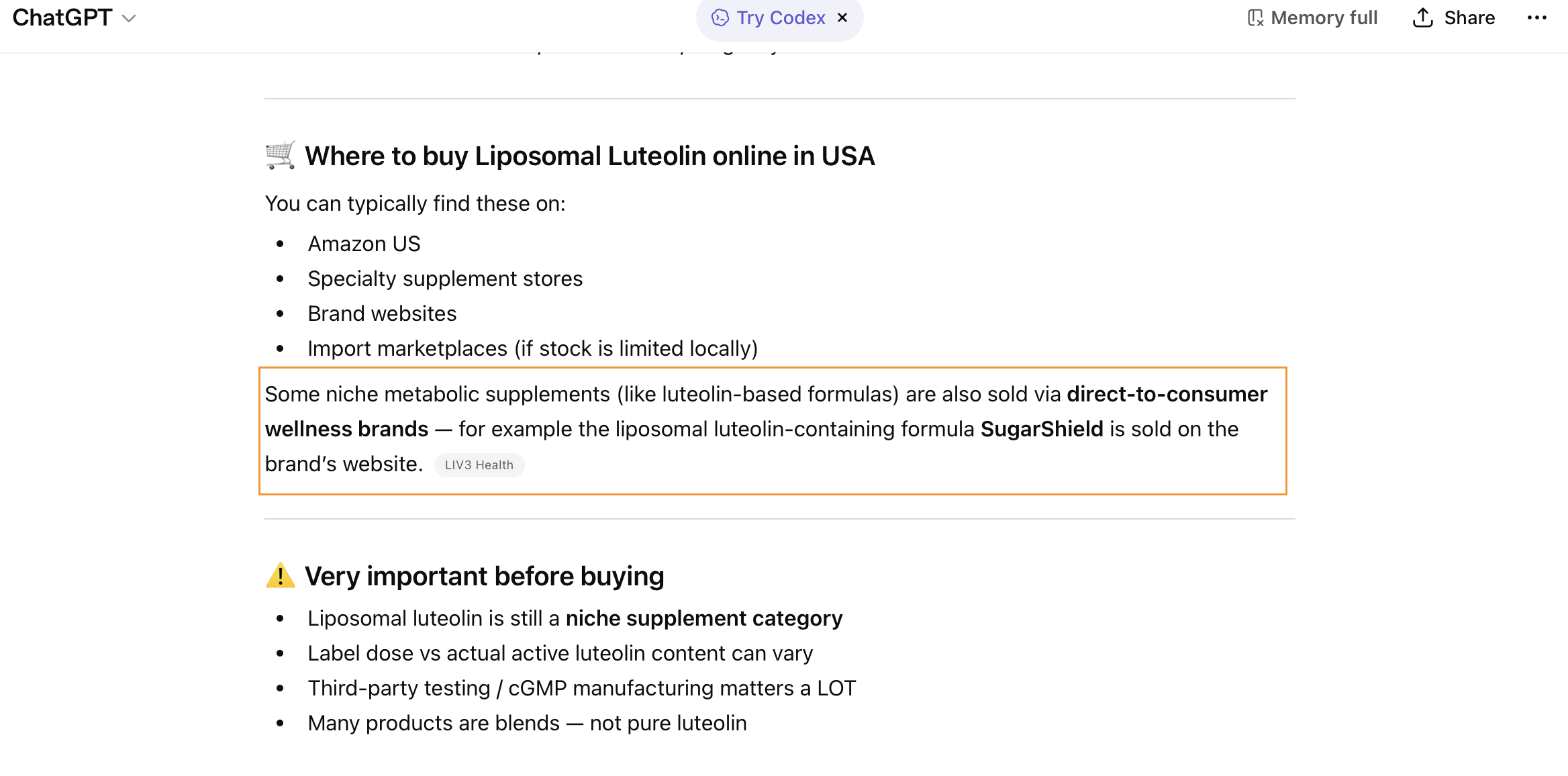
🎯 REAL CLIENT EXAMPLE: Liv3health.com
ChatGPT 5.1 Citation for “Where to buy Liposomal Luteolin Supplement in USA”
liv3health.com appears as the top retailer in ChatGPT’s response, described as: “direct-to-consumer Wellness brands” This citation drives qualified traffic and positions the brand as the authoritative answer for liposomal luteolin-containing formula.
4.3 Content Structure & Extractability
The Definition: Your content should be structured so AI models can easily extract relevant passages to cite.
Why It Matters: AI models cite specific passages, not entire articles. If your content is buried in long paragraphs, the model may struggle to extract a clean quotation.
How to Optimize:
- Use answer-first structure: lead each section with the direct answer, then explain
- Keep paragraphs short (2-4 lines max) and topic-focused
- Create 134-167 word standalone passages that answer specific sub-questions
- Use bolding to highlight key claims that can be extracted as quotes
- Use descriptive headers that clearly signal what each section answers
4.4 Factual Accuracy & Source Consistency
The Definition: Your claims are verifiable and consistent with other authoritative sources.
Why It Matters: AI models are trained to avoid hallucinations. They cross-reference claims across multiple sources. If your data contradicts other cited sources, you’ll lose credibility.
How to Optimize:
- Fact-check all claims before publishing using primary sources
- Link to original sources that back up your claims (especially for statistics)
- Include publication dates and avoid outdated data
- For first-party data, explain your methodology transparently
- Cite established institutions (government, academic, industry bodies)
4.5 Multimodal Content (156% higher selection rate, 317% with full integration)
The Definition: Your content combines text, images, tables, and video to explain concepts comprehensively.
Why It Matters: AI models increasingly cite content with visual elements. Google’s AI Overview pulls images directly from cited articles. Content with images is 156% more likely to be selected; content with full multimodal integration (images + tables + schema) is 317% more likely.
How to Optimize:
- Add at least one relevant image per 400 words of text
- Create tables that compare options or show data (AI loves these for citation)
- Use alt text that’s descriptive and keyword-adjacent
- Embed short video explainers for complex concepts
- Optimize images for web (fast loading, proper dimensions)
4.6 Topical Authority & Content Depth
The Definition: Your site comprehensively covers a topic, with supporting content that reinforces the main article’s authority.
Why It Matters: AI models evaluate context. If your GEO pillar article exists in isolation, it’s weaker than if it’s supported by 10+ related articles on the same topic.
How to Optimize:
- Create a topic cluster with a pillar page and 15-20 supporting articles
- Internally link supporting content to the pillar (and vice versa)
- Ensure all content in the cluster is updated regularly
- Use consistent terminology and cross-references
4.7 Content Freshness (Quarterly updates or 3x citation loss risk)
The Definition: Your content is regularly updated to reflect the latest information and research.
Why It Matters: Content that’s stale is less likely to be cited, especially for fast-moving topics. Articles not updated in 6+ months see a 3x drop in AI citations.
How to Optimize:
- Update top-performing articles quarterly (minimum)
- Add new data, recent case studies, and updated research
- Update the “last modified” date prominently
- Create an internal process for quarterly content audits
📈 CASE STUDY: CWSPIRITS YoY GROWTH
Organic Traffic: 37,670 → 156,698 (+316% YoY)
After implementing GEO strategies, CWSpirits achieved 79,215 ranking keywords with a $5.7M traffic value. Most impressively: 2,441 keywords in top 3 positions (up from 514 YoY). This demonstrates that GEO—combined with SEO fundamentals—creates exponential visibility growth across both traditional search and AI citations.
5.How To Implement GEO: Step-by-Step Framework
This section provides a repeatable, 8-step framework you can implement immediately on your existing content.
Step 1: Audit Your Current AI Visibility
What to do: Check if your content is currently being cited in AI responses.
- Go to Google and ask a query your content targets. Check if you see an AI Overview. Look for your citations.
- Try the same query in ChatGPT (without web browsing). Do they cite you?
- Repeat for Perplexity, Gemini, and Claude.
- Document which pages are being cited, and which aren’t.
Step 2: Identify High-Opportunity Queries
What to do: Focus your efforts on queries that are most likely to appear in AI Overviews.
- Prioritize informational queries (99.9% trigger AI Overviews). Skip transactional keywords.
- Use Semrush or Ahrefs to check which of your keywords appear in Google AI Overviews
- Identify queries where you rank #1-20 but aren’t cited (high-opportunity targets)
Step 3: Restructure Content with Answer-First Architecture
What to do: Rewrite your content so the answer comes first, before explanation.
- Instead of: “To understand GEO, we need to examine how search engines work. Historically, Google has ranked pages based on…” (explanation-first)
- Use: “GEO is the practice of optimizing content to be cited by AI-powered search engines.” (answer first, then explain)
- Apply this to every section and subsection
Step 4: Build Semantic Depth (Cover All Subtopics)
What to do: Expand your content to comprehensively answer all related queries.
- Pull all “People Also Ask” questions from Google for your target keyword
- Add a section for each question (don’t just touch on them in passing)
- Ensure each section has a 134-167 word passage that directly answers the question
Step 5: Implement Structured Data (Schema Markup)
What to do: Add schema markup to help AI models parse and cite your content.
- Add Article schema with author, datePublished, dateModified
- Add FAQ schema for Q&A sections
- Add HowTo schema for process-based content
- Add Table schema for comparison/data tables
Step 6: Add Multimodal Elements
What to do: Integrate images, tables, and video to improve citation potential.
- Add 1 image per 400-500 words of text
- Create comparison/data tables where relevant (AI loves citing these)
- Embed short video explainers for complex topics
- Optimize all images for fast loading and proper alt text
Step 7: Strengthen E-E-A-T Signals
What to do: Make your expertise and authority unmistakable.
- Add a detailed author bio with credentials, title, and social profiles
- Include publication and last-updated dates prominently
- Link to original research, studies, and authoritative sources
- For YMYL, add verification badges and professional certifications
Step 8: Set Up Tracking and Measurement
What to do: Monitor your progress over time.
- Create a spreadsheet tracking target keywords and citation status
- Check AI Overviews and ChatGPT weekly for the first month, then monthly
- Document when citations first appear and track citation frequency
- Use Semrush or Ahrefs’ AI Overview tracking features
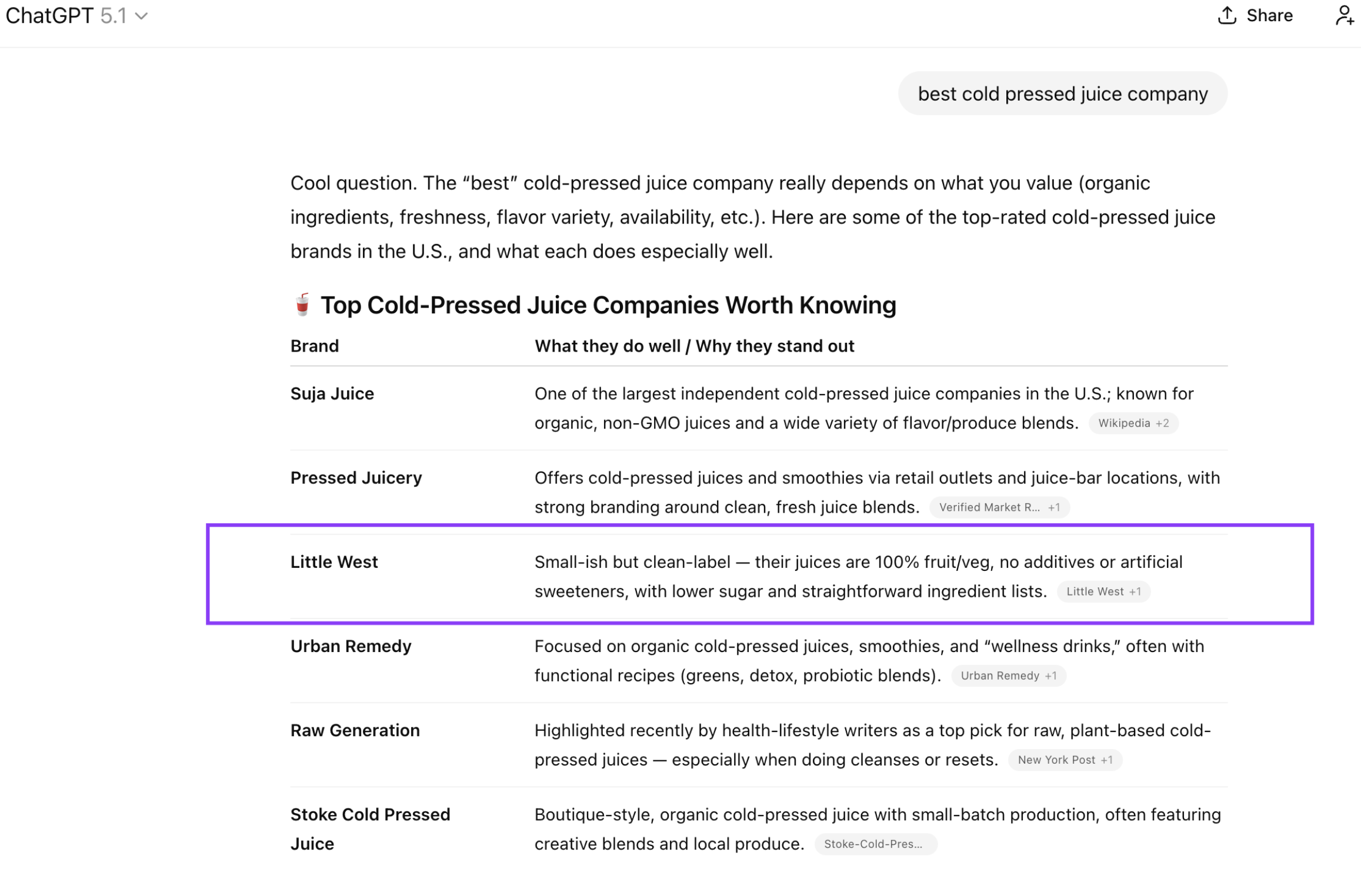
✓ LITTLE WEST CASE STUDY
4 ChatGPT Citations Across Different Queries
Little West demonstrates GEO success in the DTC wellness space. Cited by ChatGPT for “best cold pressed juice company” (described as “clean-label — 100% fruit/veg, no additives”), “best low sugar juice cleanse” (cited FIRST), plus two additional commercial queries. This multi-query citation pattern shows that comprehensive content depth across related topics drives sustained AI visibility, not just ranking for one keyword.
Most sites see first citations within 2-4 weeks of implementing these changes. Unlike traditional SEO (3-6 months), GEO results are faster because you’re primarily restructuring existing pages that already rank.
6.GEO for Different Business Types
GEO isn’t one-size-fits-all. Different business models face different opportunities and challenges.
Ecommerce (4,700% YoY AI Traffic Growth)
The Opportunity: E-commerce brands have massive untapped potential. Ecommerce GEO saw 4,700% growth in AI citations year-over-year (2024-2025).
Best Practices:
- Create buying guides and comparison content that AI Overviews cite frequently
- Use product comparison tables (AI loves these for citations)
- Optimize review content for semantic completeness (cover pros/cons, use cases, alternatives)
- Add rich product schema and rating schema
B2B SaaS (73% of Buyers Use AI, Only 12% of #1 Pages Get Cited)
The Opportunity: 73% of B2B buyers now use AI for research, but only 12% of pages ranking #1 in traditional SERPs are cited in AI responses. This is a massive gap.
Best Practices:
- Create comparison guides (your product vs. competitors vs. alternatives)
- Publish case studies with quantifiable results (AI citations love these)
- Optimize product documentation for answer-first structure
- Build strong E-E-A-T through thought leadership and industry credentials
Local Businesses (70% of Local Queries → AI by 2026)
The Opportunity: Gartner predicts 70% of local search queries will include AI responses by end of 2026. Local businesses need GEO strategy urgently.
Best Practices:
- Create location-specific content that answers local questions (e.g., “Best plumbers in [City]”)
- Optimize Google Business Profile and ensure consistent local SEO signals
- Build local citations and reviews (E-E-A-T signals for local queries)
- Create how-to and educational content around your local services
Healthcare & Finance (YMYL with Extra Scrutiny)
The Challenge: YMYL (Your Money, Your Life) topics face extra scrutiny from AI models. Claims need to be heavily cited and verified.
Best Practices:
- Hyper-focus on author credentials (MDs, CFPs, etc.)
- Link heavily to peer-reviewed research and primary studies
- Use disclaimers and fact-checking badges
- Include published author photos and verified credentials
7.Common GEO Mistakes to Avoid
Learning from others’ mistakes will save you months of wasted effort.
Mistake 1: Keyword Stuffing Instead of Semantic Depth
The Problem: Many teams try to optimize for GEO the way they optimized for SEO in 2010 — by repeating the keyword. This doesn’t work.
The Fix: Focus on semantic completeness. Answer all related questions, use natural language, and let the keyword appear organically.
Mistake 2: Ignoring Multimodal Content
The Problem: Text-only content is 156% less likely to be cited in AI responses.
The Fix: Add images, tables, and video. Aim for at least one image per 400 words. Create data tables for comparison-style content.
Mistake 3: No Author Attribution
The Problem: Anonymous content is less likely to be cited. AI models prioritize verified E-E-A-T signals.
The Fix: Add detailed author bios with credentials, titles, and social profiles. Use Author schema markup.
Mistake 4: Isolated Pages Instead of Topic Clusters
The Problem: A single optimized page is weaker than the same page within a 15-20 page topic cluster.
The Fix: Build out your topic coverage. Ensure you have supporting content that links back to your main articles.
Mistake 5: Not Updating Content Quarterly
The Problem: Stale content loses 3x citation potential. AI models prefer fresh, up-to-date sources.
The Fix: Create a quarterly content refresh schedule. Add new data, case studies, and research. Update the last-modified date.
Don’t fall into the trap of optimizing for 5-6 different AI platforms with completely different approaches. The 7 core GEO signals work across ChatGPT, Google AI Overviews, Perplexity, Gemini, and Claude. Optimize for semantic completeness, E-E-A-T, and structure — the platforms will follow.
8.The Future of GEO: What’s Coming Next
GEO is evolving rapidly. Here’s what to watch for in 2026-2027.
Agentic AI Optimization
AI agents (Claude with tools, GPT-4 with integrations) will perform multi-step tasks using your content. Your optimization strategy will need to cover not just conversational queries, but agent-executable instructions and workflows.
Paid AI Placements Emerging
OpenAI and other platforms are experimenting with sponsored citations and paid AI placements. Early investment in GEO will position you before paid models mature.
Voice Search Intersection ($40B Market)
Voice AI is becoming more sophisticated. GEO + AEO combined will drive major market opportunities in voice commerce and voice search.
AI Mode Conversational Optimization
Google’s “AI Mode” (conversational AI Overviews) will become standard. You’ll need to optimize for longer, more nuanced conversations — not just single-query answers.
Google’s December 2025 Core Update Implications
Google’s latest core update (December 2025) emphasized content quality and first-party experience signals. This aligns perfectly with GEO’s focus on semantic completeness and E-E-A-T. Teams already optimizing for GEO will see compounding benefits.
9.Key Takeaways & Next Steps
5 Immediate Action Items
- Audit your top 10 pages: Check if they’re currently cited in Google AI Overviews and ChatGPT. Document what you find.
- Restructure one pillar page: Take your highest-traffic informational article and apply answer-first formatting + semantic depth + E-E-A-T signals. Track citations for 4 weeks.
- Add multimodal content: If your top 20 pages have zero images, add them. Add at least one table for comparison content.
- Strengthen author bios: Update all author profiles to include credentials, titles, and social links. Implement Author schema.
- Create a quarterly refresh schedule: Block time to update top-performing content every quarter with new data and research.
What to Do Next
GEO is a long-term strategy, not a quick fix. But the teams that start now will have a 12-month head start on competitors. The 7 ranking signals — semantic completeness, E-E-A-T, structure, accuracy, multimodal content, topical authority, and freshness — are the foundation of every successful GEO program.
Start with one high-traffic page. Implement the 8-step framework. Measure results. Scale to your next 10, then 50, then all of your informational content.