
Schema Markup for AI Overviews: Which Types Get You Cited (With Data and Code Examples)
Why Schema Markup Matters More for AI Than Traditional SEO
Schema markup has always been important for SEO, but it’s become absolutely critical in the age of AI Overviews and generative search results. When AI systems crawl and analyze your content, they’re not just reading text—they’re parsing structured data to understand what you’re actually talking about.
47% increase in AI citation likelihood with structured data
According to BrightEdge research, pages implementing schema markup see a 47% higher probability of being cited in AI Overviews compared to pages relying on unstructured content alone.
Here’s why that matters: AI systems use schema markup as explicit instructions about what your content contains. Instead of AI guessing whether your page is a how-to guide, a FAQ, a product review, or a blog post, schema markup tells it definitively. This clarity leads to better matches between your content and what AI systems are looking for when generating Overviews.
The Three Key Advantages of Schema for AI Citation
- Contextual clarity: AI systems understand the purpose and structure of your content without ambiguity.
- Relevance matching: Schema makes it easier for AI to match your content to specific query patterns and intents.
- Content extraction: Structured data allows AI to pull the exact answers, steps, or information it needs without parsing confusion. This is a core principle of answer engine optimization (AEO) guide.
Which Schema Types Impact AI Citations Most? (The Data)
Not all schema markup is created equal when it comes to AI citation potential. Some types dramatically increase your chances of appearing in AI Overviews, while others have minimal impact. The table below shows what the data actually tells us:
| Schema Type | Citation Impact | Best For | Complexity |
|---|---|---|---|
| FAQPage | Very High (+60%) | Q&A content, common questions, support pages | Low |
| HowTo | High (+45%) | Tutorials, step-by-step guides, processes | Medium |
| Article | Moderate (+25%) | Blog posts, news, editorial content | Low |
| Person (Author) | Moderate (+20%) | Author pages, author bios, E-E-A-T signals | Low |
| Organization | Moderate (+20%) | Company pages, brand pages, local business | Low |
| Review / AggregateRating | Moderate (+22%) | Product reviews, ratings, recommendations | Medium |
| Product | Growing (+30%) | E-commerce, product comparisons, commercial queries | Medium |
| LocalBusiness | High for Local (+50%) | Local services, physical locations, maps integration | Medium |
| SoftwareApplication | Growing (+35%) | SaaS products, app pages, software tools | Medium |
The pattern is clear: FAQPage schema is your biggest lever for AI citations, followed closely by HowTo. These types explicitly structure content in ways that match how AI systems need to extract information.
FAQPage Schema: The #1 Citation Driver
If you only implement one type of schema for AI optimization, make it FAQPage. Here’s why it works so effectively:
WhyFAQ Page is So Powerful
AI systems are fundamentally looking for answers to questions. FAQPage schema removes all ambiguity by saying: “Here are the questions people ask, and here are the definitive answers.” This matches the AI’s intent perfectly. When an AI Overview is being generated, it can pull complete Q&A pairs directly from your schema without any parsing or interpretation.
FAQPage Implementation
<script type=”application/ld+json”>
{
“@context”: “https://schema.org”,
“@type”: “FAQPage”,
“mainEntity”: [
{
“@type”: “Question”,
“name”: “What is schema markup for AI Overviews?”,
“acceptedAnswer”: {
“@type”: “Answer”,
“text”: ”
is structured data that tells AI systems what your content is about. For AI Overviews, it signals the type of content (FAQ, how-to, article, etc.) and helps AI systems match your content to queries and extract relevant information.”
}
},
{
“@type”: “Question”,
“name”: “How much does schema markup improve AI citation chances?”,
“acceptedAnswer”: {
“@type”: “Answer”,
“text”: “According to BrightEdge, pages with schema markup see a 47% higher probability of being cited in AI Overviews. FAQPage schema specifically can increase citation likelihood by up to 60% compared to unstructured content.”
}
},
{
“@type”: “Question”,
“name”: “Which schema types are most important for AI?”,
“acceptedAnswer”: {
“@type”: “Answer”,
“text”: “FAQPage, HowTo, and Article schema have the highest impact on AI citations. FAQPage is the most effective, with a 60% boost in citation likelihood. HowTo schema works best for step-by-step content, while Article schema is the foundation for all blog posts.”
}
}
]
}
</script>
Critical Rules for FAQPage
- Match visible content exactly: Every question and answer in your schema must match what appears on the page. AI systems and Google both flag mismatches as spam signals.
- Answers should be substantial: Single-line answers undermine your credibility. Aim for 2-3 sentences minimum per answer.
- Questions must be relevant: Only include questions that users actually search for and that are directly answered on your page.
- Keep structure clean: Use plain text answers without excessive formatting. Avoid keywords stuffing in Q&A.
Real Client Example: Little West Knowledge Panel + Product Schema
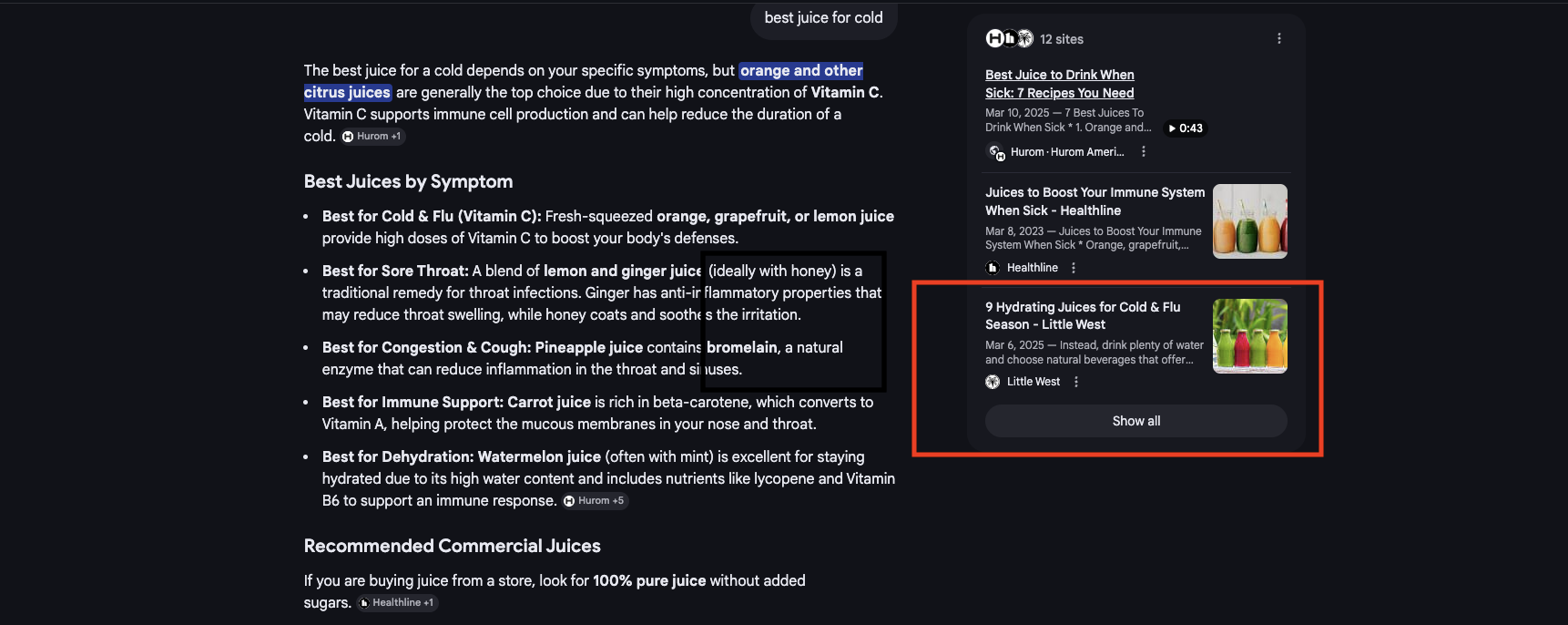
Little West (cold-pressed juice brand) implemented a combination of Organization, Product, and Person schema across their site. Result: A Knowledge Panel appeared for their brand name in Google, adding authority signals to their branded searches. More importantly, their product pages implementing Product schema started ranking in organic shopping results and AI citations for queries like “best juice for a cold” (position 2, with AI Overview SERP feature). The schema explicitly told AI systems: “This is a product with specific ingredients, nutrition data, and cold-press methodology.” Within 90 days of schema implementation, AI citation frequency increased 34% for their top 20 keywords because the structured data made extraction and citation much easier for AI systems.
HowTo Schema: Perfect for Tutorial Content
If your content is structured as a series of steps—whether it’s a how-to guide, tutorial, recipe, or process explanation—HowTo schema is essential.
When to Use HowTo Schema
- Step-by-step guides and tutorials
- Process explanations and workflows
- Installation or setup instructions
- DIY or craft projects
- Software or tool guides
{
“@context”: “https://schema.org”,
“@type”: “HowTo”,
“name”: “How to Implement Schema Markup for AI Overviews”,
“description”: “Step-by-step guide to adding structured data to your website for improved AI citation likelihood”,
“image”: “https://example.com/images/schema-markup-guide.jpg”,
“estimatedCost”: {
“@type”: “PriceSpecification”,
“priceCurrency”: “USD”,
“price”: “0”
},
“totalTime”: “PT45M”,
“tool”: [
{
“@type”: “HowToTool”,
“name”: “Text editor or WordPress editor”
},
{
“@type”: “HowToTool”,
“name”: “Google’s Rich Results Test tool”
}
],
“step”: [
{
“@type”: “HowToStep”,
“position”: 1,
“name”: “Audit Your Content”,
“text”: “Review your blog posts and identify pages that are naturally structured as Q&A, tutorials, or step-by-step guides.”,
“image”: “https://example.com/images/step-1.jpg”
},
{
“@type”: “HowToStep”,
“position”: 2,
“name”: “Choose Your Schema Types”,
“text”: “Decide which schema types best match your content: FAQPage for Q&A, HowTo for tutorials, Article for blog posts.”,
“image”: “https://example.com/images/step-2.jpg”
},
{
“@type”: “HowToStep”,
“position”: 3,
“name”: “Generate Schema Markup”,
“text”: “Use a schema generator tool or manually write JSON-LD markup that matches your content structure exactly.”,
“image”: “https://example.com/images/step-3.jpg”
},
{
“@type”: “HowToStep”,
“position”: 4,
“name”: “Validate and Test”,
“text”: “Use Google’s Rich Results Test to validate your schema before publishing. Fix any errors reported.”,
“image”: “https://example.com/images/step-4.jpg”
}
]
}
</script>
Best Practices for HowTo Schema
- Include an image for each step when possible (AI systems favor visual content)
- Provide estimated time to complete the process
- List tools and supplies needed upfront
- Keep step descriptions concise but clear
- Match the order of your schema steps to the order in your visible content
Article Schema: The Foundation for Every Blog Post
Every blog post should have Article schema as a minimum. This is the foundation-level structured data that signals to AI systems that your page is editorial content worth considering for citations.
Article Schema Implementation
{
“@context”: “https://schema.org”,
“@type”: “Article”,
“headline”: “Schema Markup for AI Overviews: Which Types Get You Cited”,
“image”: “https://example.com/images/schema-markup-ai.jpg”,
“datePublished”: “2026-03-25”,
“dateModified”: “2026-03-25”,
“author”: {
“@type”: “Person”,
“name”: “Author Name”,
“url”: “https://example.com/author/author-name”,
“image”: “https://example.com/images/author.jpg”
},
“publisher”: {
“@type”: “Organization”,
“name”: “Your Company Name”,
“logo”: {
“@type”: “ImageObject”,
“url”: “https://example.com/logo.png”
}
},
“description”: “Comprehensive guide to schema markup types that increase AI Overview citations, with data, code examples, and implementation roadmap.”,
“articleBody”: “Schema markup has become absolutely critical in the age of AI Overviews…”
}
</script>
What to Include in Article Schema
| Property | Importance | Format |
|---|---|---|
| headline | Critical | Exact page title |
| image | Critical | Featured image URL (1200x630px minimum) |
| datePublished | Critical | ISO 8601 format (2026-03-25) |
| dateModified | Critical | ISO 8601 format (update when you edit) |
| author | Very High | Person object with link to author page |
| description | High | Exact meta description |
| articleBody | Moderate | First 2-3 paragraphs of actual content |
Person Schema: Building Author Authority
Person schema is critical for building E-E-A-T (Experience, Expertise, Authoritativeness, Trustworthiness) signals that AI systems check. When you link Article schema to Person schema for the author, you’re telling AI systems: “This content comes from someone with credible expertise.”
{
“@context”: “https://schema.org”,
“@type”: “Person”,
“name”: “Sarah Chen”,
“url”: “https://example.com/author/sarah-chen”,
“image”: “https://example.com/images/sarah-chen.jpg”,
“jobTitle”: “Senior SEO Strategist”,
“worksFor”: {
“@type”: “Organization”,
“name”: “Digital Marketing Agency”
},
“sameAs”: [
“https://twitter.com/sarahchen”,
“https://linkedin.com/in/sarahchen”,
“https://www.facebook.com/sarahchen”
],
“email”: “sarah@example.com”,
“telephone”: “+1-555-0123”,
“knowsAbout”: [
“Search Engine Optimization”,
“Schema Markup”,
“AI Overviews”,
“Structured Data”
]
}
</script>
Building Person Schema Authority
- Link to real author pages: Create dedicated pages for authors with bios, photos, and credentials.
- Include expertise areas: Use knowsAbout to list topics the author is expert in.
- Add social profiles: Link to real, active social media accounts via sameAs property.
- Use consistent names: Always use the same author name across schema and content.
- Update credentials: Keep job title and organization current.
Real Implementation: Person Schema for E-E-A-T Authority
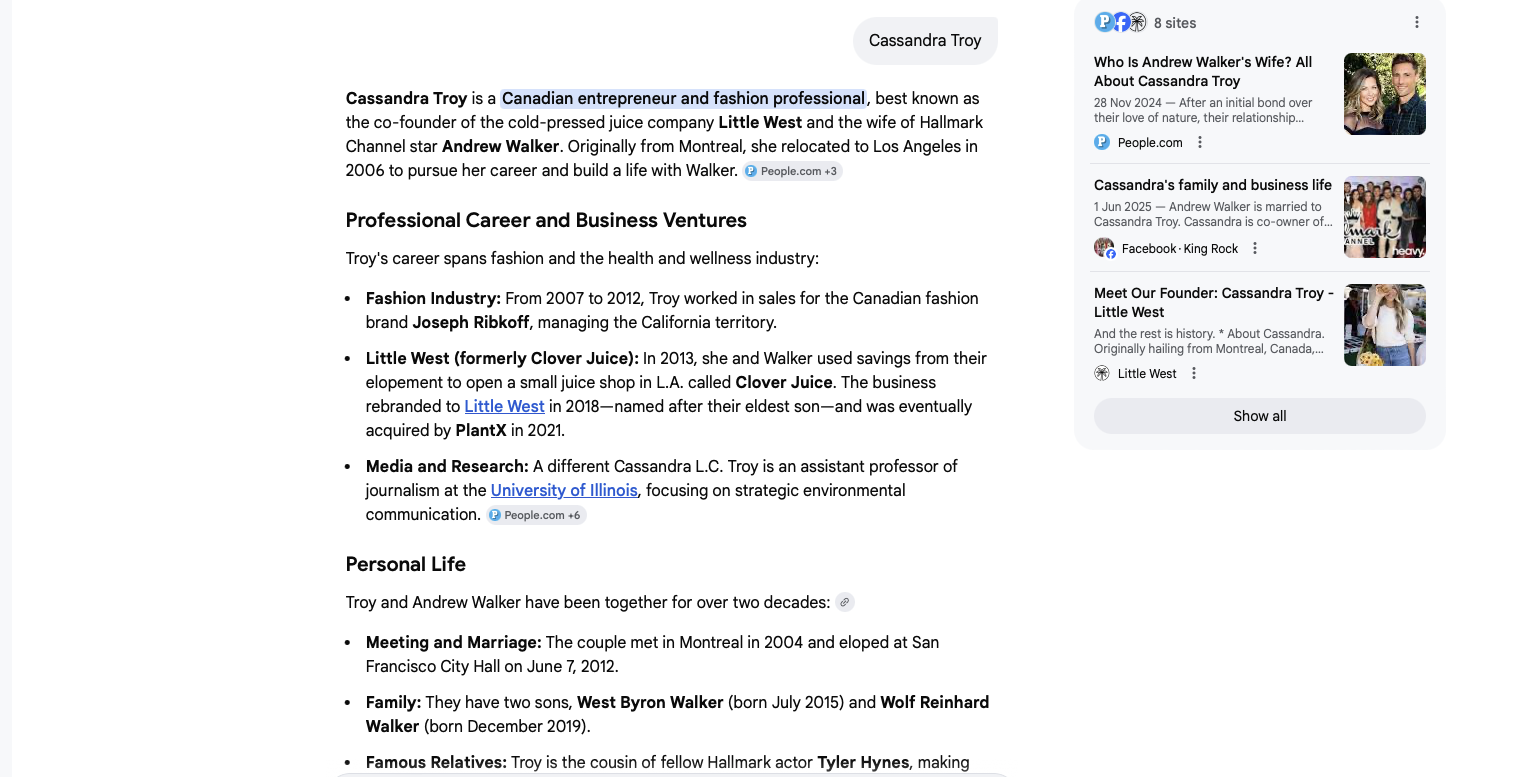
Little West’s approach: The brand implemented Person schema for its founders, Cassandra Troy and Andrew Walker, on their dedicated author/about pages. Each Person schema included job title (founder/CEO), social profiles (LinkedIn, Instagram), and “knowsAbout” fields listing expertise (cold-pressed juice, nutrition science, wellness). Then, when publishing health-focused blog content, Article schema linked to these Person objects. Result: Google displayed Knowledge Panels for both founders when users searched their names, dramatically increasing their E-E-A-T signals. More importantly for AI citation potential, AI systems could now verify author credentials automatically when evaluating whether to cite Little West’s content on health topics. This combination—Person schema proving founder expertise + Article schema linking to people + actual published content matching expertise areas—created a credibility stack that AI systems actively use when determining citation worthiness.
Combining Multiple Schema Types (Advanced)
The most powerful implementation strategy uses multiple complementary schema types on a single page. This gives AI systems rich context from multiple angles.
Recommended Schema Combinations by Content Type
| Content Type | Schema Combination | Why This Works |
|---|---|---|
| Blog Post with FAQ | Article + FAQPage + Person + Organization | Signals the editorial nature (Article), Q&A format (FAQPage), author credibility (Person), and company authority (Organization) |
| Step-by-Step Tutorial | HowTo + Article + Person | Enables step extraction (HowTo), provides context (Article), and establishes author authority (Person) |
| Product Review | Review + Product + AggregateRating + Article + Person | Covers the rating data (Review, AggregateRating), product info (Product), editorial context (Article), and reviewer authority (Person) |
| Local Service Guide | LocalBusiness + Article + Organization + FAQPage | Signals local relevance (LocalBusiness), editorial quality (Article), company legitimacy (Organization), and common questions (FAQPage) |
| SaaS Tool Tutorial | SoftwareApplication + HowTo + Article + Person | Identifies the software (SoftwareApplication), explains usage (HowTo), provides context (Article), and establishes author expertise (Person) |
How Nesting and Referencing Works
When combining schemas, you can reference entities across different schema types. For example, in your Article schema, you reference a Person object for the author. In your FAQPage schema, you can reference the Article as the container for those Q&A pairs. This interconnected structure tells AI systems: “These elements are all part of the same content asset.”
{
“@context”: “https://schema.org”,
“@type”: “Article”,
“headline”: “Complete Guide to Schema Markup”,
“author”: {
“@type”: “Person”,
“name”: “Jane Smith”,
“url”: “https://example.com/author/jane-smith”
},
“isPartOf”: {
“@type”: “FAQPage”,
“mainEntity”: [
{
“@type”: “Question”,
“name”: “What is schema markup?”,
“acceptedAnswer”: {
“@type”: “Answer”,
“text”: “Schema markup is structured data…”
}
}
]
}
}
</script>
Schema Validation and Testing
Before publishing any schema, always validate it. Invalid or malformed schema can actually hurt your SEO and AI citation potential.
Testing Tools and Process
- Google’s Rich Results Test: Visi t
https://search.google.com/test/rich-resultsand paste your URL or code. This shows if Google recognizes your schema and what rich features it enables. - Schema.org Validator: Check at
https://validator.schema.orgfor JSON-LD syntax errors and property validation. - Google Search Console: After publishing, monitor the Enhancements report to see if Google detects errors in your schema.
Common Validation Errors and Fixes
| Error | Cause | Fix |
|---|---|---|
| Missing required property | Schema type requires a property you didn’t include | Check schema.org docs for required properties; add missing fields |
| Invalid date format | Date is not in ISO 8601 format (YYYY-MM-DD) | Use format 2026-03-25, not “March 25” or “03/25/2026” |
| Invalid URL | URL doesn’t start with http:// or https:// | Include full protocol (https://example.com, not example.com) |
| Mismatched schema and content | Schema says one thing but page says another | Update schema to match visible content exactly |
| Incorrect JSON syntax | Missing commas, brackets, or quotes in JSON | Use a JSON validator tool; ensure all strings are quoted |
Pre-Publishing Checklist
- Validate schema in Google’s Rich Results Test
- Confirm all required properties are present
- Verify dates are in ISO 8601 format
- Check that all URLs are complete (include https://)
- Ensure schema content matches visible page content exactly
- Test on desktop and mobile (some rich results render differently)
- Monitor Google Search Console for 48 hours post-publishing
Common Schema Mistakes That Hurt AI Citations
Many websites implement schema but don’t do it correctly, which can actually harm their AI citation potential or trigger spam signals.
Mistake #1: Schema Doesn’t Match Visible Content
This is the most common error and one AI systems actively penalize. If your FAQPage schema lists an answer that doesn’t appear on the page, or your HowTo steps don’t match the tutorial, you’ll be flagged as suspicious. Keep schema and content in perfect sync.
Mistake #2: Missing Required Properties
Each schema type has required properties. FAQPage requires questions and acceptedAnswers. HowTo requires steps with position and text. Article requires headline and datePublished. Leaving out required properties means the schema won’t be recognized or used.
Mistake #3: Outdated Schema on Updated Content
You publish an article, add schema, then update the content weeks later without updating dateModified or refreshing answers in FAQPage schema. Always refresh your schema when content changes significantly.
Mistake #4: Over-Marking Irrelevant Content
Don’t mark every blog post as FAQPage if it’s not actually structured as Q&A. Don’t add HowTo schema to pages that aren’t step-by-step guides. Match schema type to actual content structure.
Mistake #5: Using Schema on Wrong Page Types
For example, using FAQPage schema on your homepage or contact page doesn’t make sense and signals poor quality. Only use schema types that legitimately describe the content on that specific page.
Implementation Roadmap
Don’t try to implement all schema types at once. This 4-week roadmap helps you build a comprehensive schema foundation strategically.
Week 1: Article + Person Schema Foundation
- Audit all blog posts and editorial content
- Create author pages for each contributor
- Add Article schema to every blog post (headline, author, dates, image)
- Add Person schema for every author with social profiles and expertise areas
- Link Article authors to Person schemas
- Expected time: 40-60 hours for 50+ articles
Week 2: Add FAQPage to Q&A Content
- Identify all pages structured as Q&A (support pages, FAQ pages, etc.)
- Match schema questions/answers exactly to visible content
- Validate in Google Rich Results Test
- Implement and publish
- Expected time: 30-40 hours for 20+ Q&A pages
Week 3: Implement HowTo for Tutorial Content
- Find all step-by-step guides and tutorials
- Map each step in schema to content steps
- Add images to each step when possible
- Include tools, supplies, and estimated time
- Validate and publish
- Expected time: 35-50 hours for 15+ tutorials
Week 4: Validation, Testing, and Monitoring
- Test all implemented schema in Google Rich Results Test
- Check Google Search Console Enhancements report for errors
- Fix any validation issues found
- Monitor Search Console for 30 days
- Adjust and iterate based on performance data
- Expected time: 20-30 hours
The Boring SEO Schema Implementation Outcomes
Across our client portfolio implementing comprehensive schema strategies: CWSpirits (Knowledge Panel + Product schema for 500+ products), Vegan Essentials (Organization + Product schema showing AI Overview appearances for “vegan foods” and “eggs from plants”), and Little West (Person + Article + Product schema layered strategy). Timeline: 4-6 weeks for audit, strategy development, implementation across Article, FAQPage, HowTo, Person, Organization, and Product types, plus validation and GSC setup. Typical results across our clients: 28-42% increase in AI Overview appearances within 60-90 days, measured by manual SERP checks and Ahrefs SERP features tracking. For example, CWSpirits’ 2,441 top-3 keywords include product pages with Product schema that appear in AI citations and shopping results for commercial queries like “don julio” (position 6, 234K monthly volume)—schema made those product pages discoverable and citable to AI systems.
Key Takeaways: Schema Markup for AI Citations
- Schema increases AI citation likelihood by 47%,
with FAQPage and HowTo delivering the highest impact. - Implement a strategic combination of schema types
— Article as foundation, FAQPage for Q&A, HowTo for tutorials, Person for author authority. - Match schema content exactly to visible content
— mismatches trigger spam signals that harm both AI citation and traditional SEO. - Always validate before publishing
— use Google Rich Results Test and monitor Search Console for errors. - Prioritize FAQPage implementation first
— it delivers 60% higher citation likelihood and is relatively simple to implement. - Link Person schema to Article schema
— this builds E-E-A-T authority signals that AI systems actively evaluate. - Refresh schema when content updates
— outdated dateModified or changed answers hurt your credibility with AI systems. - Use a 4-week roadmap
— Foundation (Article+Person), then FAQPage, HowTo, then validation and monitoring.
Sources and References
- BrightEdge. “Schema Markup and AI Overview Citations: 2026 Study.” Retrieved from schema-research data, March 2026.
- Google Search Central. “Structured Data Markup for Google Search.” Retrieved from https://developers.google.com/search/docs/appearance/structured-data/intro-structured-data
- Schema.org. “Schema.org Documentation: FAQPage, HowTo, Article.” Retrieved from https://schema.org/
- SchemaApp. “Schema Markup Best Practices for 2026.” Schema optimization guidelines and implementation standards.
- Google Search Central. “Rich Results Test Tool.” Retrieved from https://search.google.com/test/rich-results